The Pace Egg plays are an Easter custom in rural Northern England in the tradition of the medieval mystery plays. The practice was once common throughout Northern England, but largely died out in the nineteenth century before being revived in some areas of Lancashire and West Yorkshire in the twentieth century. The plays, which involved mock combat, were performed by Pace Eggers, who sometimes received gifts of decorated eggs from villagers. Several closely related folk songs were associated with Pace Egging.
St George slaying Bold Slasher at the Heptonstall Pace Egg Play
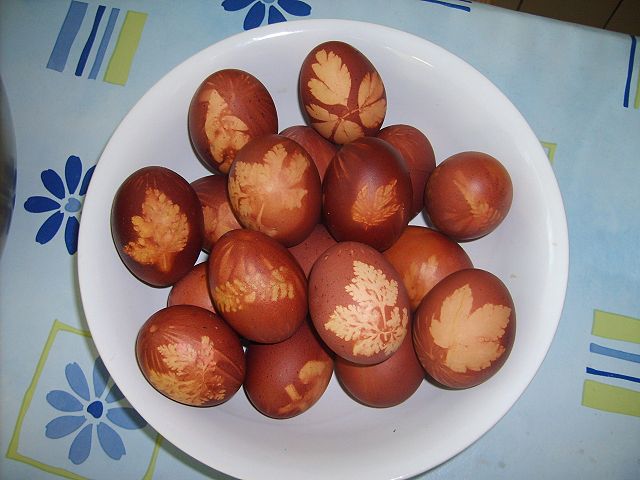
Pace eggs boiled with onion skins and leaf patterns
Pace Egg Play, Upper Calder Valley
Egg decorating is the art or craft of decorating eggs. It has been a popular art form throughout history because of the attractive, smooth, oval shape of the egg, and the ancient associations with eggs as a religious and cultural symbol. Egg decorating has been associated with Easter in recent times, but was practiced independently by many ancient cultures.
Ukrainian pysanka
Easter egg sculptures resembling pisanica in front of the Zagreb Cathedral, Croatia
A Carthaginian decorated egg from the Iron Age