Pair-instability supernova
Videos
A pair-instability supernova is a type of supernova predicted to occur when pair production — the production of free electrons and positrons in the collision between atomic nuclei and energetic gamma

When a star is very massive, the gamma rays produced in its core can become so energetic that some of their energy is drained away into production of particle and antiparticle pairs. The resulting drop in radiation pressure causes the star to partially collapse under its own huge gravity. After this violent collapse, runaway thermonuclear reactions (not shown here) ensue and the star explodes.

G299 Remnants Super Nova Type 1a 20150218
Stellar population
Videos
In 1944, Walter Baade categorized groups of stars within the Milky Way into stellar populations. In the abstract of the article by Baade, he recognizes that Jan Oort originally conceived this type of
Pair-instability supernova
…from around 130 to 250 solar masses and low to moderate metallicity (low abundance of elements other than hydrogen and helium – a situation common in Population III stars). Photons given off by a body in thermal equilibrium have a black-body spectrum with an energy density proportional to the fourth power of the temperature…

Artist's conception of the spiral structure of the Milky Way showing Baade's general population categories. The blue regions in the spiral arms are composed of the younger population I stars, while the yellow stars in the central bulge are the older population II stars. In reality, many population I stars are also found mixed in with the older population II stars.
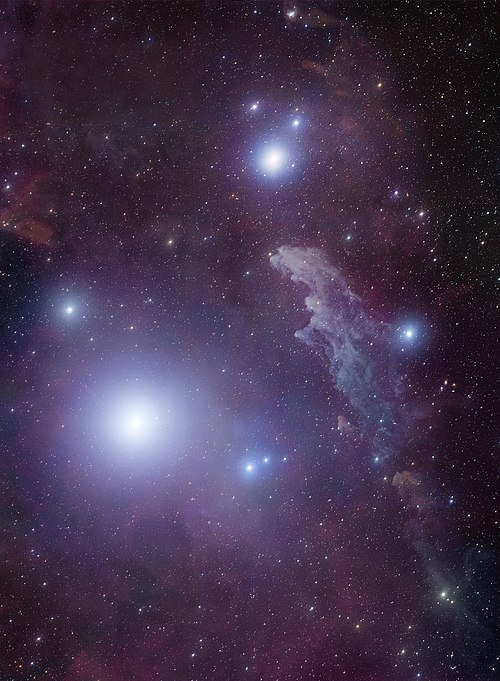
Population I star Rigel with reflection nebula IC 2118

Artist's impression of a field of population III stars 100 million years after the Big Bang.

Possible glow of population III stars imaged by NASA's Spitzer Space Telescope