Pali Canon
Videos
The Pāḷi Canon is the standard collection of scriptures in the Theravada Buddhist tradition, as preserved in the Pāli language. It is the most complete extant early Buddhist canon. It derives mainly f
Standard edition of the Thai Pali Canon

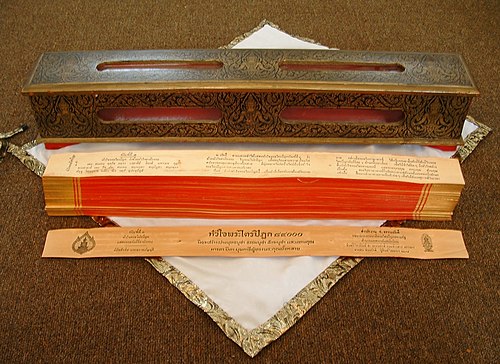
In pre-modern times the Pali Canon was disseminated through oral tradition and palm-leaf manuscripts. The leaves are kept together by thin sticks, and the scripture is covered in cloth and kept in a box.

Burmese-Pali manuscript copy of the Buddhist text Mahaniddesa, showing three different types of Burmese script, (top) medium square, (centre) round and (bottom) outline round in red lacquer from the inside of one of the gilded covers

Folios of the Bhikkhuni patimokkha
Buddhist canons
Videos
There are several Buddhist canons, which refers to the various scriptural collections of Buddhist sacred scriptures or the various Buddhist scriptural canons. Some of these collections are also called
Pali Canon
…Upali recited the Vinaya Pitaka. The Arhats present accepted the recitations, and henceforth, the teachings were preserved orally by the Sangha. The Tipitaka that was transmitted to Sri Lanka during the reign of King Asoka was initially preserved orally and later written down on palm leaves during the Fourth…

Tipiṭaka manuscripts on Gold Plates, Burma

Xuanzang transporting Buddhist scriptures to China

A cabinet containing a modern edition of the entire Pali Canon