Palynology
Videos
Palynology is the study of microorganisms and microscopic fragments of macroorganisms that are composed of acid-resistant organic material and occur in sediments, sedimentary rocks, and even some meta
Pollen and spore grains seen under differen research-grade microscopes, including confocal microscopy.


Pollen core sampling, Fort Bragg, North Carolina

Pine pollen under a modern simple light microscope
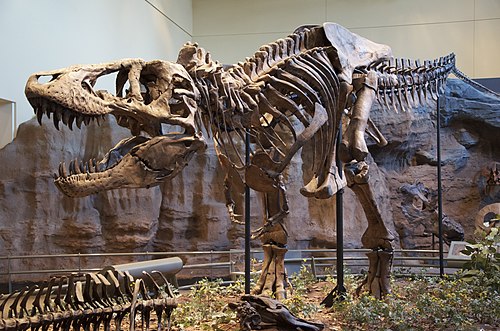
Tyrannosaurus Rex Holotype
Paleobotany
Videos
Paleobotany or palaeobotany, also known as paleophytology, is the branch of botany and paleontology dealing with the recovery and identification of plant fossils from geological contexts, and their us
Palynology
…geology or geological science) and biological science (biology), particularly plant science (botany). Biostratigraphy, a branch of paleontology and paleobotany, involves fossil palynomorphs from the Precambrian to the Holocene for their usefulness in the relative dating and correlation of sedimentary strata…

A fossil Betula leopoldae (birch) leaf from the Early Eocene of Washington state, approximately 49 million years ago

An unpolished hand sample of the Lower Devonian Rhynie Chert from Scotland

Ginkgoites huttonii, Middle Jurassic, Yorkshire, UK. Leaves preserved as compressions. Specimen in Munich Palaeontological Museum, Germany.

Rhynia, Lower Devonian Rhynie Chert, Scotland, UK. Transverse section through a stem preserved as a silica petrifaction, showing preservation of cellular structure.