Many species of flies of the two-winged type, Order Diptera, such as mosquitoes, horse-flies, blow-flies and warble-flies, cause direct parasitic disease to domestic animals, and transmit organisms that cause diseases. These infestations and infections cause distress to companion animals, and in livestock industry the financial costs of these diseases are high. These problems occur wherever domestic animals are reared. This article provides an overview of parasitic flies from a veterinary perspective, with emphasis on the disease-causing relationships between these flies and their host animals. The article is organized following the taxonomic hierarchy of these flies in the phylum Arthropoda, order Insecta. Families and genera of dipteran flies are emphasized rather than many individual species. Disease caused by the feeding activity of the flies is described here under parasitic disease. Disease caused by small pathogenic organisms that pass from the flies to domestic animals is described here under transmitted organisms; prominent examples are provided from the many species.

Adult Chrysomya megacephala blowfly, known as bazaar fly, feeding by sponging at organic waste from where it may transmit harmful bacteria

1-Complex mouthparts, 2-Paired antennae, 3-Head, 4-Compound eye, 5-Thorax, 6-Open tube heart, 7-Salivary gland, 8-One pair of wings, 9-Halter, 10-Excretory (Malpighian) tube, 11-Gut, 12-Ovary (or testis), 13-Abdomen, 14-Legs (3 pairs), 15-Thoracic ganglion of nervous system, 16-Spiracle opening to respiratory tube (trachea)

Aedes aegypti female mosquito engorging with blood.

Lifecycle of Stomoxys showing a typical complete metamorphosis from eggs at top left, to three larval stages, followed by transformation as the pupal stage into an adult female or male
Culicoides
Videos
Culicoides is a genus of biting midges in the family Ceratopogonidae. There are over 1000 species in the genus, which is divided into many subgenera. Several species are known to be vectors of various diseases and parasites which can affect animals. The genus has a long fossil record, with earliest known fossils being from Burmese amber, around 99 million years old.
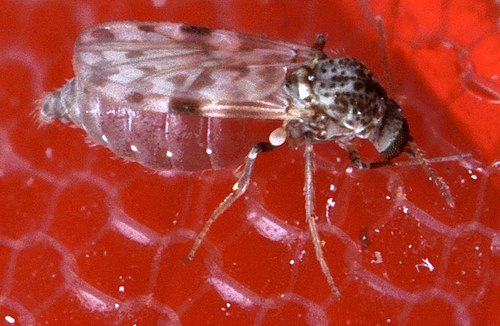

Culicoides brevitarsis

Culicoides impunctatus (left) and culicine mosquito (right)