Particle accelerator
Videos
A particle accelerator is a machine that uses electromagnetic fields to propel ions to very high speeds and energies to contain them in well-defined beams. Small accelerators are used for fundamental

The Tevatron (background circle), a synchrotron collider type particle accelerator at Fermi National Accelerator Laboratory (Fermilab), Batavia, Illinois, USA. Shut down in 2011, it was the most powerful particle accelerator in the world until 2007, accelerating protons to an energy of over 1 TeV (tera electron volts). Beams of protons and antiprotons, circulating in opposite directions in the rear ring, collided at two magnetically induced intersection points.

Beamlines leading from the Van de Graaff accelerator to various experiments, in the basement of the Jussieu Campus in Paris.

A Cockcroft–Walton generator (Philips, 1937), residing in Science Museum (London).

A 1960s single stage 2 MeV linear Van de Graaff accelerator, here opened for maintenance
CERN
Videos
The European Organization for Nuclear Research, also called European Laboratory for Particle Physics, known as CERN, is an intergovernmental organization that operates the largest particle physics lab
Particle accelerator
…Ion Collider at Brookhaven National Laboratory in New York and the largest accelerator, the Large Hadron Collider near Geneva, Switzerland, operated by CERN. It is a collider accelerator, which can accelerate two beams of protons to an energy of 6.5 TeV and cause them to collide head-on, creating center-of-mass…

CERN's main site in Meyrin, Switzerland, looking towards the French border
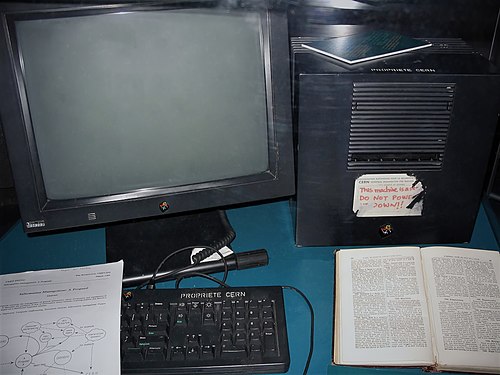
This NeXT Computer used by British scientist Sir Tim Berners-Lee at CERN became the first Web server.

This Cisco Systems router at CERN was one of the first IP routers deployed in Europe.
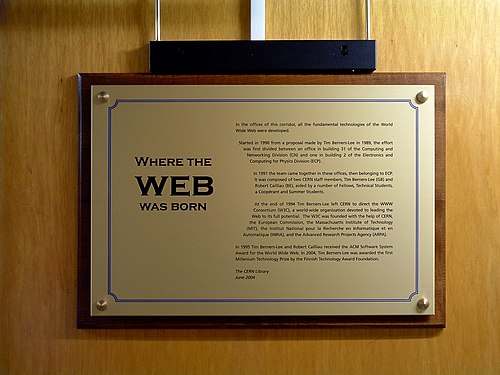
A plaque at CERN commemorating the invention of the World Wide Web by Tim Berners-Lee and Robert Cailliau