Passengers of the Titanic
A total of 2,240 people sailed on the maiden voyage of the Titanic, the second of the White Star Line's Olympic-class ocean liners, from Southampton, England, to New York City. Partway through the voyage, the ship struck an iceberg and sank in the early morning of 15 April 1912, resulting in the deaths of 1,517 passengers and crew.
Georgette Madill, first-class passenger
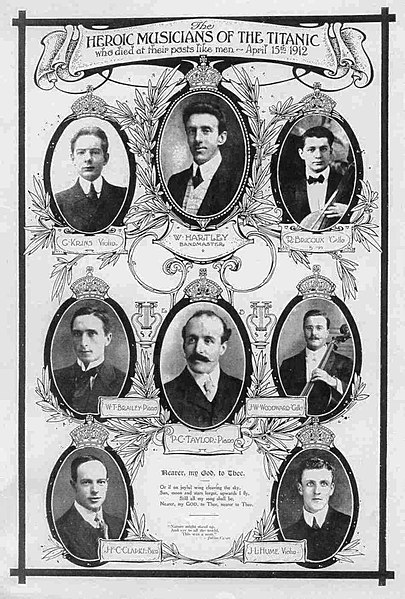
The Titanic's musicians, led by Wallace Hartley, were employed as crew, but given second-class accommodations.
Michel, right, and Edmond Navratil, the "Titanic Orphans"
A typical third-class cabin
Iceberg that sank the Titanic
The passenger steamer Titanic collided with an iceberg and sank on the night of 14–15 April 1912 in the North Atlantic. Of the approximate 2,200 people on board, over 1,500 did not survive. After the disaster, there was interest in the iceberg itself to explain the circumstances of the collision and the resulting damage to the supposedly unsinkable ship. Because of the Titanic disaster, an International Ice Patrol was founded whose mission was to reduce the dangers of ice to shipping.
'Iceberg' at the Titanic Museum in Branson, Missouri, whose building is modeled on the famous ship
Greenland with the Jakobshavn Glacier (white oblong area at the bottom of the picture)
The Titanic as she leaves the Irish port of Queenstown on 11 April 1912. This was the last stop before the voyage into the North Atlantic.
The Marconigram of the Amerika, which came to the Hydrographic Office in Washington via the Titanic and Cape Race. It reported two icebergs seen by the ship at a certain spot on 14 April.