Pataliputra capital
Videos
The Pataliputra capital is a monumental rectangular capital with volutes and Classical Greek designs, that was discovered in the palace ruins of the ancient Mauryan Empire capital city of Pataliputra.

Pataliputra palace capital (front and side view), early Maurya Empire period, 3rd century BCE. Bihar Museum, Patna

Front and the back views of the Pataliputra capital (drawing). The back has a few broken portions (top right corner), and a slightly less detailed and slightly coarser design.

The Classical designs on the Pataliputra capital include rosettes, bead and reels, waves, beaded moldings, volutes with inserted rosette, and stylicized flame palmette. Bihar Museum, 2022
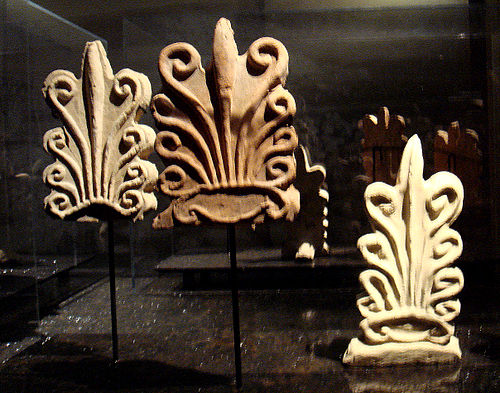
The "flame palmette" design is well attested from Ai Khanoum, Afghanistan, 3rd-2nd century BCE.
Bulandi Bagh
Videos
Bulandi Bagh is an area within the archaeological site of Pataliputra, located north of the railway station in the modern city of Patna. It is mainly known for the discovery of the monumental Patalipu
Pataliputra capital
…India). It is dated to the 3rd century BCE. The monumental capital was discovered in 1895 at the royal palace in Pataliputra, India, in the area of Bulandi Bagh in Patna, by archaeologist L.A. Waddell in 1895. It was found at a depth of around 12 feet (3.7 meters), and dated to the reign of Ashoka or soon after…

Bulandi Bagh is located in the northwestern corner, just above the railroad, of the 1895 excavation plan at Pataliputra (marked "Bulandhi Bagh" and "I").

Location of Bulandi Bagh in the ancient city of Pataliputra and modern Patna (Pataliputra city limits in dotted line).

Mauryan remains of wooden palissade at the Bulandi Bagh site, 1912–13.