The Paus collection is a collection of classical sculpture that mostly forms part of the National Museum of Norway, and previously of its predecessor, the National Gallery. The collection was created in the late 19th and early 20th centuries by papal chamberlain and count Christopher Tostrup Paus, who lived in Rome at the time; it was moved to his Swedish estate Trystorp during the First World War and later partly to his estate Herresta. At the time it was mostly possible to export antique objects from Italy. Previously the largest private collection of classical sculpture in the Nordic countries, it was largely donated to the Norwegian government by Paus between 1918 and 1929 as the intended foundation of a Norwegian museum or department of classical sculpture. Some objects from the Paus collection were also acquired by other museums, including Ny Carlsberg Glyptotek.
Count Christopher Paus, who created the collection when living in Rome
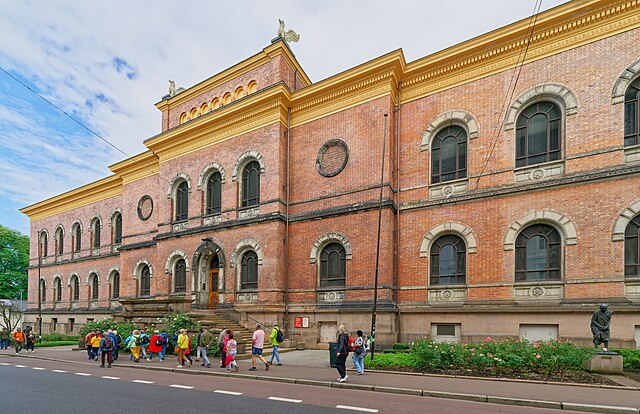
The National Gallery, where the collection was on display 1918–2019
Image: Trajan, ca. 103 17, National Gallery, Oslo (36069109740) (cropped)
National Museum of Norway
The National Museum is a museum in Oslo, Norway which holds the Norwegian state's public collection of art, architecture, and design objects. The collection totals over 400,000 works, amongst them the first copy of Edvard Munch's The Scream from 1893. The museum is state-owned and managed by the Norwegian Ministry of Culture.
Nye Nasjonalmuseet in Vika, Oslo, Norway
The old National Gallery building, completed in 1882
Count Christopher Paus, the creator of the Paus collection and founder of the National Gallery's antiquities collection
The Paus Trajan, a bust of Trajan that is part of the Paus collection that was donated to the National Gallery by papal chamberlain Christopher Paus from 1918