Pavonia, New Netherland
Videos
Pavonia was the first European settlement on the west bank of the North River that was part of the seventeenth-century province of New Netherland in what would become the present Hudson County, New Jersey.

The replica Half Moon at mouth of the Hudson River approaching Lower Manhattan, site of New Amsterdam, with Hoboken, part of Pavonia, in background at left

1664 Duke's Plan includes depictions of either Harsimus, Paulus Hook, or Communipaw at time of the surrender of Fort Amsterdam. Bergen was farther inland atop Bergen Hill. Ellis Island and Liberty Island are seen lower right.

Newport, built on the previously landfilled Harsimus Cove from the Hudson River

Pavonia branch library
New Netherland
Videos
New Netherland was a 17th-century colonial province of the Dutch Republic located on the east coast of what is now the United States of America. The claimed territories extended from the Delmarva Peninsula to Cape Cod. Settlements were established in what became the states of New York, New Jersey, Delaware, and Connecticut, with small outposts in Pennsylvania and Rhode Island.

The West India House in Amsterdam, headquarters of the Dutch West India Company from 1623 to 1647

St. Mark's Church in-the-Bowery, site of Peter Stuyvesant's grave
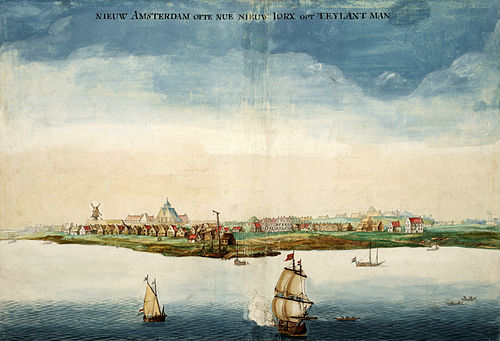
Image of Nieuw Amsterdam made in 1664, the year that it was surrendered to English forces under Richard Nicolls
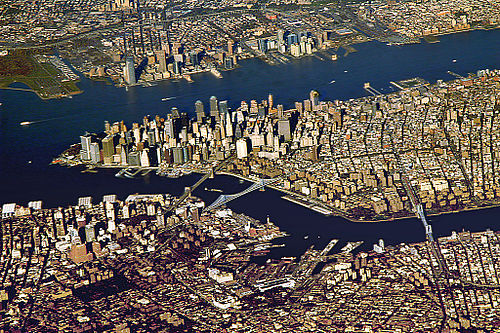
The original New Netherland settlements at Brooklyn, Manhattan, and Jersey City have grown into the New York metropolitan area, the largest metropolitan area in the United States