Permeability (spatial and transport planning)
In urban design, permeability and connectivity are terms that describe the extent to which urban forms permit movement of people or vehicles in different directions. The terms are often used interchangeably, although differentiated definitions also exist. Permeability is generally considered a positive attribute of an urban design, as it permits ease of movement and avoids severing neighbourhoods. Urban forms which lack permeability, e.g. those severed by arterial roads, or with many long culs-de-sac, are considered to discourage movement on foot and encourage longer journeys by car. There is some empirical research evidence to support this view.
This cul-de-sac retrofit exemplifies the difference between connectivity and permeability in practice. It was created to improve traffic flow on a major commercial "Main Street" by "filtering" cars out at this junction. Bicycles and pedestrians retain full accessibility
History of permeability of different types of traffic over time, in industrialised cities
A dead end, also known as a cul-de-sac, or a no through road or no exit road, is a street with only one combined inlet and outlet.
Cul-de-sac dead end in La Crosse, Wisconsin
A dead end in Alicante, Spain
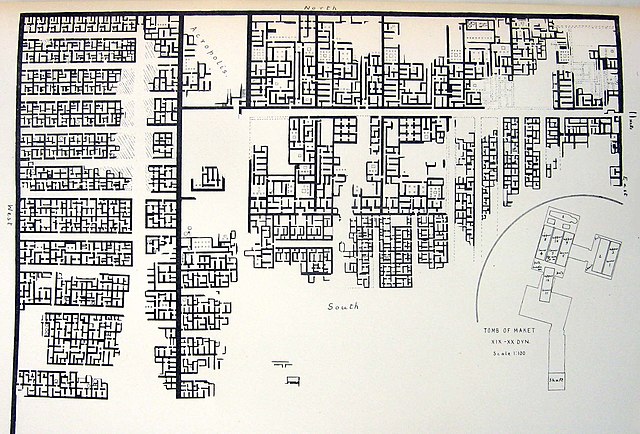
Workers' village at El Lahun pyramid site, Egypt (c. 1885 BC)
Two dead ends, made by closing a minor road in the center to block through-traffic