Persian language
Videos
Persian, also known as Farsi, is a Western Iranian language belonging to the Iranian branch of the Indo-Iranian subdivision of the Indo-European languages. Persian is a pluricentric language predomina
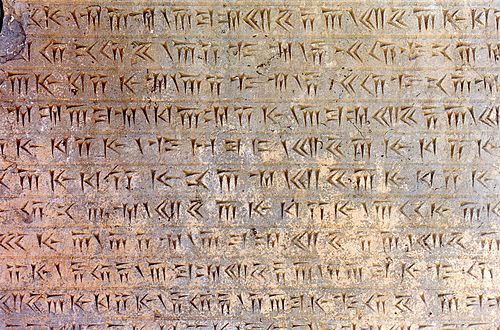
An Old Persian inscription written in Old Persian cuneiform in Persepolis, Iran

Middle Persian text written in Inscriptional Pahlavi on the Paikuli inscription from between 293 and 297. Slemani Museum, Iraqi Kurdistan.

Ferdowsi's Shahnameh

Persian notes on Quranic booklets, written by a native of Tus called Ahmad Khayqani in 292 AH (905 CE)
Persian alphabet
Videos
The Persian alphabet, also known as the Perso-Arabic script, is the right-to-left alphabet used for the Persian language. An Arabic-based alphabet, it is largely identical to the Arabic alphabet with
Persian language
…as within other regions with a Persianate history in the cultural sphere of Greater Iran. It is written officially within Iran and Afghanistan in the Persian alphabet, a derivative of the Arabic script, and within Tajikistan in the Tajik alphabet, a derivative of the Cyrillic script. Modern Persian is a continuation…

A page from a 12th century manuscript of "Kitab al-Abniya 'an Haqa'iq al-Adwiya" by Abu Mansur Muwaffaq with special Persian letters p (پ), ch (چ) and g (گ = ڭـ).

Example showing the Nastaʿlīq calligraphic style's proportion rules

Nastaliq Persian Calligram the Persian letter Mem