Personification of the Americas
Videos
Photos
Early European personifications of America, meaning the Americas, typically come from sets of the four continents: Europe, Asia, Africa, and America. These were all that were then known in Europe. The addition of America made these an even more attractive group to represent visually, as sets of four could be placed around all sorts of four-sided objects, or in pairs along the facade of a building with a central doorway.

Meissen porcelain, c. 1760, modeled by Johann Joachim Kändler, who did several versions of the Four continents

America, from the Four continents engraved by Julius Goltzius after design by Maerten de Vos, before 1595. Fighting and cannibalism in the background.

Set of porcelain figures, German, c. 1775, from left: Asia, Europe, Africa, America, with parrot and cornucopia.

Giovanni Battista Tiepolo, fresco in the Würzburg Residenz, 1750s. America sits on a huge alligator.
Personification
Videos
Photos
Personification is the representation of a thing or abstraction as a person. It is, in other words, considered an embodiment or an incarnation. In the arts, many things are commonly personified. These include numerous types of places, especially cities, countries, and continents, elements of the natural world such as the trees or four seasons, four elements, four cardinal winds, five senses, and abstractions such as virtues, especially the four cardinal virtues and seven deadly sins, the nine Muses, or death.
Set of porcelain figures of personifications of the four continents, German, c. 1775, from left: Asia, Europe, Africa, and America. Of these, Africa has retained her classical attributes. Formerly James Hazen Hyde collection.

Jean Goujon, The Four Seasons, reliefs on the Hôtel Carnavalet, Paris, c. 1550s.

Sandro Botticelli, Calumny of Apelles (c. 1494–95), with 8 personification figures: (from left) Hope, Repentance, Perfidy, innocent victim, Calumny, Fraud, Rancour, Ignorance, the king, Suspicion.
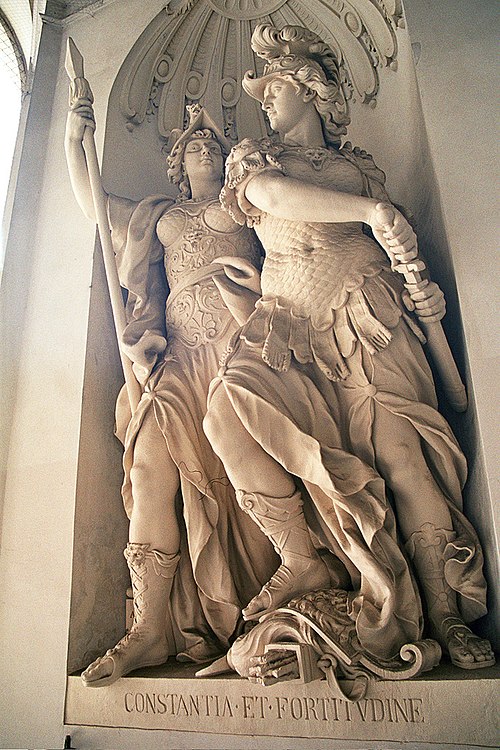
Constance and Fortitude in Vienna. Early modern statues with classical iconography.