The petalonamids (Petalonamae) are an extinct group of archaic animals typical of the Ediacaran biota, also called frondomorphs, dating from approximately 635 million years ago to 516 million years ago. They are benthic and motionless animals,
that have the shape of leaves, fronds (frondomorphic), feathers or spindles and were initially considered algae, octocorals or sea pens. It is now believed that there are no living descendants of the group, which shares a probable relation to the Ediacaran animals known as Vendozoans.
Petalonamae
The Ediacaran biota is a taxonomic period classification that consists of all life forms that were present on Earth during the Ediacaran Period. These were enigmatic tubular and frond-shaped, mostly sessile, organisms. Trace fossils of these organisms have been found worldwide, and represent the earliest known complex multicellular organisms. The term "Ediacara biota" has received criticism from some scientists due to its alleged inconsistency, arbitrary exclusion of certain fossils, and inability to be precisely defined.
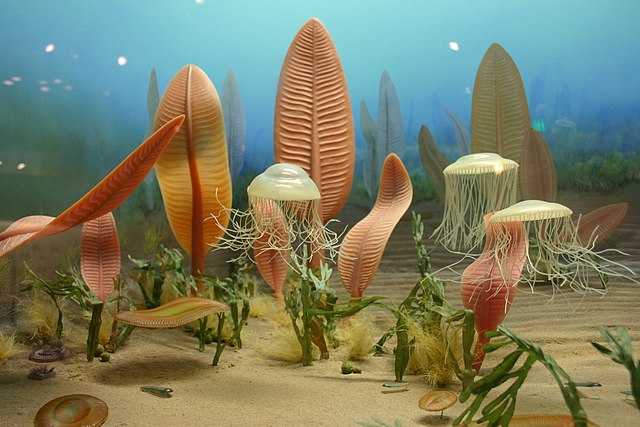
Life in the Ediacaran Period, as imagined by researchers in 1980.
Palaeontologist Guy Narbonne examining Ediacaran fossils in Newfoundland
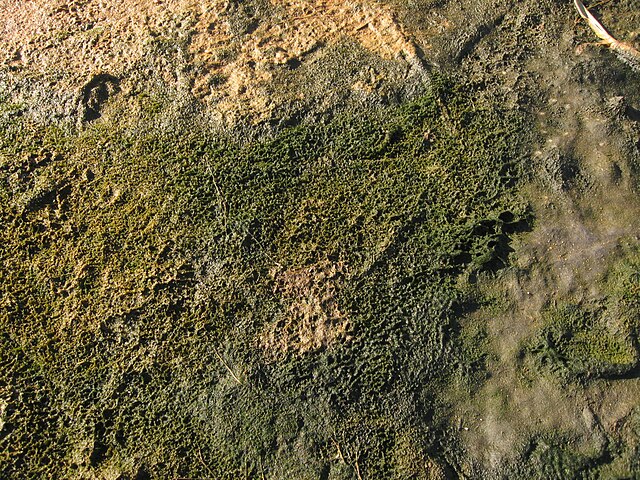
Modern cyanobacterial-algal mat, salty lake on the White Sea seaside
A reconstruction of the Ediacaran biota at the Field Museum in Chicago