Peter the Great
Videos
Peter I, better known as Peter the Great, was Tsar of all Russia from 1682 and the first Emperor of Russia from 1721 until his death in 1725. He reigned jointly with his half-brother Ivan V until 1696
Portrait by Jean-Marc Nattier, 1717


Peter as a child

Double throne in Kremlin Armoury. A large hole was cut in the back of the dual-seated throne used by Ivan and Peter. Sophia would sit behind the throne and listen as Peter conversed with nobles, while feeding him information and giving him responses to questions and problems.
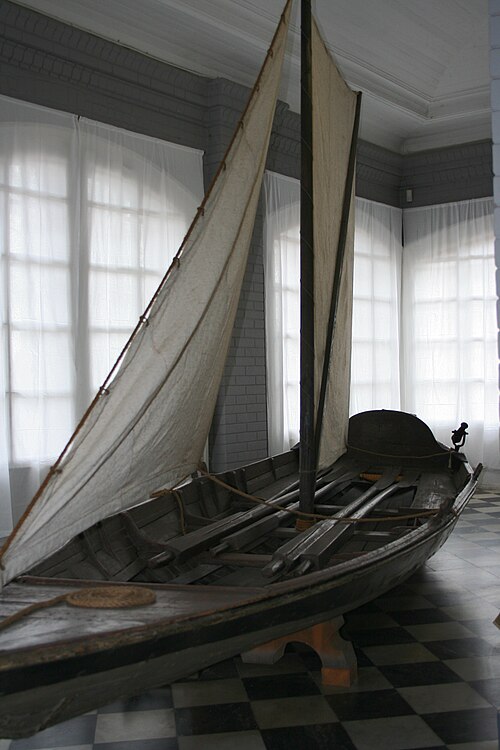
Peter's ship, rigged with a sail and a mast with the help of Dutch carpenters
Alexei Petrovich Romanov, was the Tsarevich of Russia, the eldest son of Tsar Peter I and his first wife, Eudoxia Lopukhina.
Peter the Great
…sought to end his unhappy marriage. He divorced the tsaritsa and forced her to join a convent. She had borne him three children, although only one, Alexei Petrovich, Tsarevich of Russia, survived past his childhood. Menshikov introduced him to Marta Helena Skowrońska, the daughter of a Polish-Lithuanian peasant, and took her as a…

Portrait of Alexei by Johann Gottfried Tannauer, c. 1712–1716

Charlotte Christine, Tsarevna of Russia

Portrait by Christoph Bernhard Francke, undated

Peter the Great Interrogating the Tsarevich Alexei Petrovich at Peterhof, by Nikolai Ge, 1871, Tretyakov Gallery, Moscow