Philip of Swabia
Videos
Philip of Swabia, styled Philip II in his charters, was a member of the House of Hohenstaufen and King of Germany from 1198 until his assassination.
Philip of Swabia with the Imperial Regalia, miniature in the Chronicle of Weissenau Abbey, ca. 1250. Kantonsbibliothek St. Gallen (Vadiana Collection, Ms. 321, p. 40.)


Frederick Barbarossa with his sons Henry and Philip, from Peter of Eboli Liber ad honorem Augusti, 1196. Burgerbibliothek of Berne, Codex 120 II, fol. 143r.

Philip of Swabia. Chronica Sancti Pantaleonis, Köln, Kloster St. Pantaleon, ca. 1237. Wolfenbüttel, Herzog August Library, Cod. Guelf. 74.3 Aug. 2°.

Philip of Swabia. Chronica regia Coloniensis (13th century), Brussels, Royal Library of Belgium, Ms. 467, fol. 138r.
Frederick Barbarossa
Videos
Frederick Barbarossa, also known as Frederick I, was the Holy Roman Emperor from 1155 until his death in 1190. He was elected King of Germany in Frankfurt on 4 March 1152 and crowned in Aachen on 9 Ma
Philip of Swabia
…his reign. Philip was born in or near Pavia in the Imperial Kingdom of Italy as the tenth child and eighth (but fifth and youngest surviving) son of Frederick Barbarossa, King of Germany and Holy Roman Emperor and his second wife Beatrice I, Countess of Burgundy. His paternal family was the noble House of Hohenstaufen…
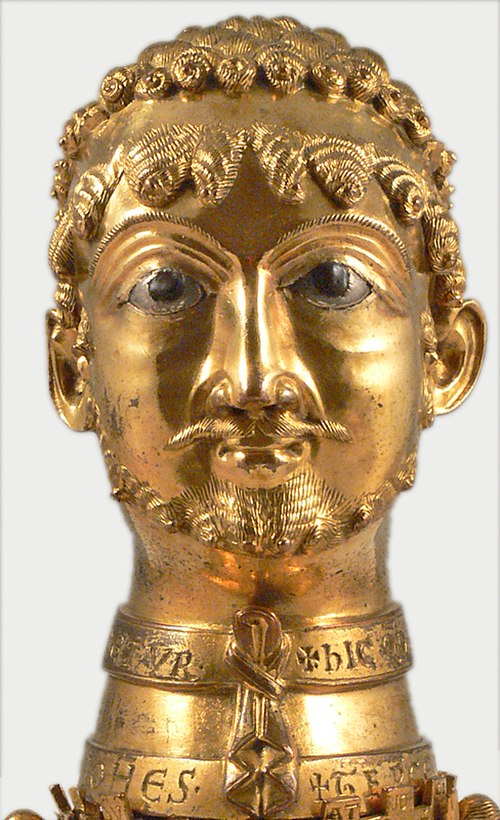
A golden bust of Frederick as John the Baptist, given to his godfather Count Otto of Cappenberg in 1171. It was used as a reliquary in Cappenberg Abbey in Germany, and is said in the deed of the gift to have been made "in the likeness of the emperor".

Crusaders besieging Damascus in 1148

13th-century stained glass image of Frederick I, Strasbourg Cathedral

Penny or denier with Emperor Frederick I Barbarossa, struck in Nijmegen