Phobos (moon)
Videos
Phobos is the innermost and larger of the two natural satellites of Mars, the other being Deimos. The two moons were discovered in 1877 by American astronomer Asaph Hall. Phobos is named after the Gre

A false color composite image of Phobos captured by the Mars Reconnaissance Orbiter in 2008

Deimos and Phobos as seen from Mars, compared in apparent size to the Moon as seen from Earth

An artist's concept of Martian Moons eXploration spacecraft

The Phobos monolith (right of center) as taken by the Mars Global Surveyor (MOC Image 55103, 1998)
Deimos (moon)
Videos
Deimos is the smaller and outer of the two natural satellites of Mars, the other being Phobos. Deimos has a mean radius of 6.2 km and takes 30.3 hours to orbit Mars. Deimos is 23,460 km from Mars, muc
Phobos (moon)
…Phobos () is the innermost and larger of the two natural satellites of Mars, the other being Deimos. The two moons were discovered in 1877 by American astronomer Asaph Hall. Phobos is named after the Greek god of fear and panic, who is the twin brother…
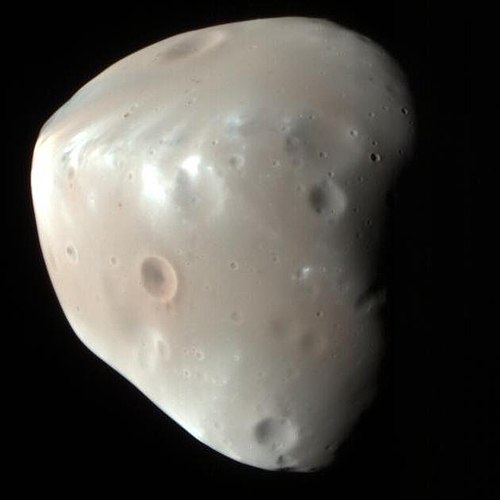
Deimos, captured by the Mars Reconnaissance Orbiter in false color

Asaph Hall III, discoverer of Deimos

Deimos transits the Sun – as viewed by the Mars rover Opportunity (4 March 2004)