Phosphate
Videos
A phosphate is an anion, salt, functional group or ester derived from a phosphoric acid. It most commonly means orthophosphate, a derivative of orthophosphoric acid, a.k.a. phosphoric acid H3PO4.

Phosphate mine near Flaming Gorge, Utah, US, 2008

Train loaded with phosphate rock, Métlaoui, Tunisia, 2012

Phosphate imports/exports in 1937
Nucleotide
Videos
Nucleotides are organic molecules composed of a nitrogenous base, a pentose sugar and a phosphate. They serve as monomeric units of the nucleic acid polymers – deoxyribonucleic acid and ribonucleic ac
Phosphate
…also be present as pyrophosphate anions P2O74−, which give orthophosphate by hydrolysis: Organic phosphates are commonly found in the form of esters as nucleotides (e.g. AMP, ADP, and ATP) and in DNA and RNA. Free orthophosphate anions can be released by the hydrolysis of the phosphoanhydride bonds in ATP or ADP…
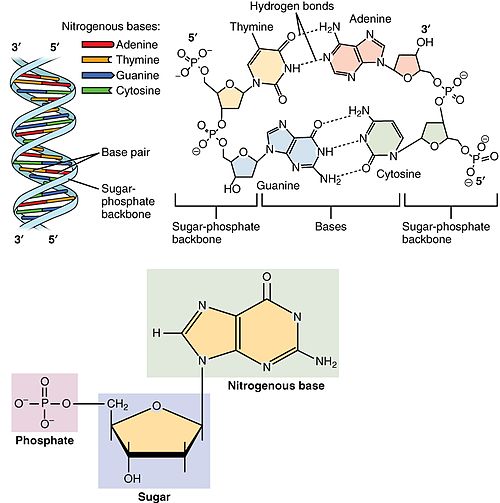
Showing the arrangement of nucleotides within the structure of nucleic acids: At lower left, a monophosphate nucleotide; its nitrogenous base represents one side of a base-pair. At the upper right, four nucleotides form two base-pairs: thymine and adenine (connected by double hydrogen bonds) and guanine and cytosine (connected by triple hydrogen bonds). The individual nucleotide monomers are chain-joined at their sugar and phosphate molecules, forming two 'backbones' (a