Pidgeon process
Videos
The Pidgeon process is a practical method for smelting magnesium. The most common method involves the raw material, dolomite, being fed into an externally heated reduction tank and then thermally redu
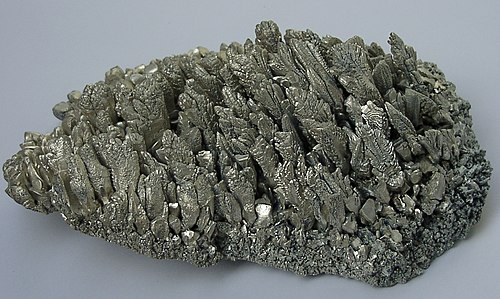
Vapor-deposited magnesium crystals from the Pidgeon process

Enormous asbestos mittens must be worn by men handling the thousands of hot magnesium ingots produced daily at Basic Magnesium's giant plant in the southern Nevada desert in Gabbs, Nevada near Las Vegas. Full operation commenced in the summer of 1943.

Flow chart showing steps taken during the Pidgeon process

Schematic cut of a retort: (a) outlet for creating a vacuum, (b) cold water inlet and outlet, (c) retort door, (d) magnesium crown, (e) heat shield, and (f) retort furnace wall.
Ferrosilicon
Videos
Ferrosilicon is an alloy of iron and silicon. It has a typical silicon content of 15–90% by weight and a high proportion of iron silicides.
Pidgeon process
…involves the raw material, dolomite, being fed into an externally heated reduction tank and then thermally reduced to metallic magnesium using 75% ferrosilicon as a reducing agent in a vacuum. Overall the processes in magnesium smelting via the Pidgeon process involve dolomite calcination, grinding and pelleting…

Ferrosilicon alloy