Planetary habitability
Videos
Planetary habitability is a measure used in astrobiology to characterize a planet's or a natural satellite's potential to develop and sustain an environment hospitable to life. The Planetary Habitabil

Understanding planetary habitability is partly an extrapolation of the conditions on Earth, as this is the only planet known to support life.

The moons of some gas giants could potentially be habitable.

An artist's impression of GJ 667 Cc, a potentially habitable planet orbiting a red dwarf constituent in a trinary star system

PDS 70
Ocean world
Videos
An ocean world, ocean planet, water world, or water planet is a type of planet or natural satellite that contains a substantial amount of water in the form of oceans, as part of its hydrosphere, eithe

Earth's surface is dominated by the ocean, which forms 71% of Earth's surface. Thus, Earth can be considered a water world, although not a fully oceanic world.

Diagram of the interior of Enceladus. Ice crust Global ocean Rocky core The southern polar region shows active jets.

A set of exoplanets of varying size containing water, compared with the Earth (artist concept; 17 August 2018)
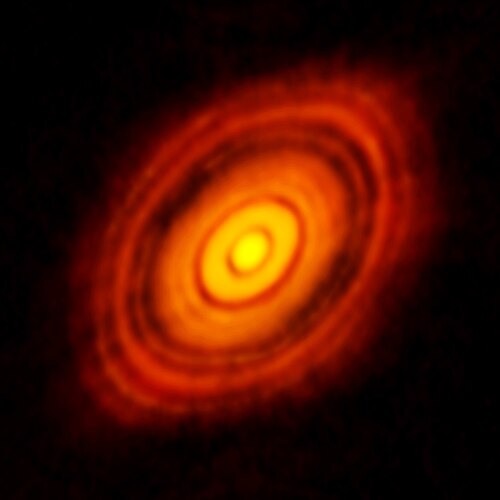
Atacama Large Millimeter Array image of HL Tauri, a protoplanetary disk