Air-to-air combat is the engagement of combat aircraft in warfare in which primarily fixed-wing aircraft attempt to destroy enemy aircraft using guns, rockets and missiles.

The last moments of a U.S. Air Force recon C-130 Hercules in gun camera of the Soviet MiG-17 (2 September 1958)

Gun camera sequence photos showing a North Vietnamese MiG-17 being hit and shot down by 20 mm shells from a U.S. Air Force F-105D Thunderchief during the Vietnam War (3 June 1967)
Israeli Air Force
Videos
The Israeli Air Force operates as the aerial and space warfare branch of the Israel Defense Forces. It was founded on May 28, 1948, shortly after the Israeli Declaration of Independence. As of May 202
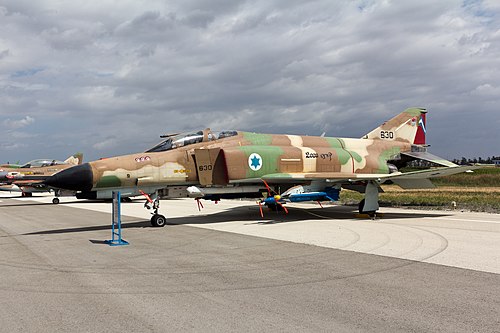
201 Squadron IAF F-4E Phantom II with 3 kill markings

An Israeli Air Force A-4N Skyhawk of 102 Squadron "Flying Tiger"

An F-16A Netz #107 of 116 Squadron "Defenders Of The South" with 7.5 kill marks, including the triangle symbol for Operation Opera

69 Squadron F-15I Ra'ams at Red Flag 04-3