Powhatan
Videos
Photos
The Powhatan people (;) are Native Americans who belong to member tribes of the Powhatan Confederacy, or Tsenacommacah. They are Algonquian peoples whose historic territories were in eastern Virginia.
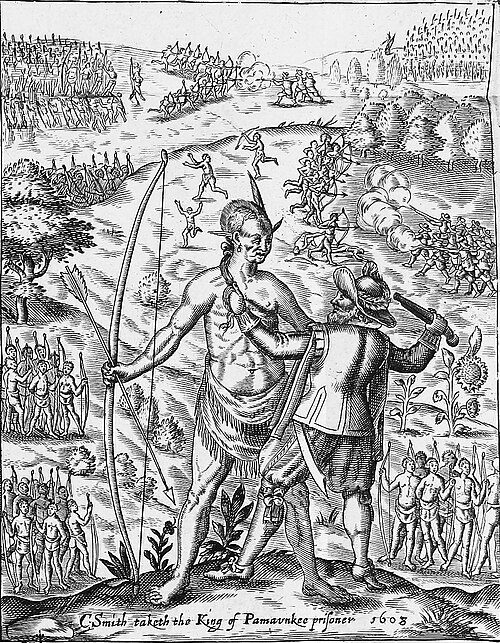
'John Smith taking the King of Pamunkey prisoner', a fanciful image of Opechancanough from Smith's General History of Virginia (1624). The image of Opechancanough is based on a 1585 painting of another Native warrior by John White[1]

The Coronation of Powhatan, oil on canvas, John Gadsby Chapman, 1835

Reconstructed Powhatan village at the Jamestown Settlement living-history museum.
Tsenacommacah
Videos
Photos
Tsenacommacah is the name given by the Powhatan people to their native homeland, the area encompassing all of Tidewater Virginia and parts of the Eastern Shore. More precisely, its boundaries spanned 100 miles (160 km) by 100 miles (160 km) from near the south side of the mouth of the James River all the way north to the south end of the Potomac River and from the Eastern Shore west to about the Fall Line of the rivers.

The Powhatan Confederacy ca. 1607
Reconstructed Powhatan village at the Jamestown Settlement living-history museum.