The Pratt & Whitney R-2800 Double Wasp is an American twin-row, 18-cylinder, air-cooled radial aircraft engine with a nominal displacement of 2,800 cu in, and is part of the long-lived Wasp family of
A preserved R-2800 engine at the National Museum of the United States Air Force

Cutaway of a Pratt & Whitney R-2800 Double Wasp

The first prototype F4U Corsair, the earliest aircraft specifically designed to use the Double Wasp

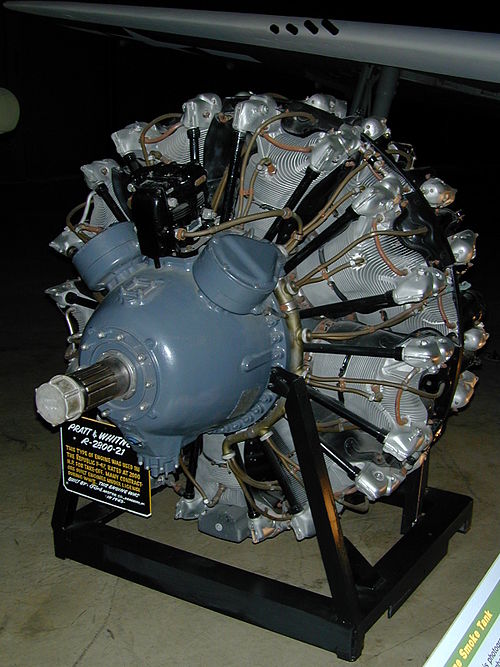
A preserved "B Series" R-2800-21 or -59. The A and B series can be most readily identified by their smooth, single-piece nose casings. This photo shows the simplified tubular ignition harness fitted to some R-2800 subtypes.
Grumman F6F Hellcat
Videos
The Grumman F6F Hellcat is an American carrier-based fighter aircraft of World War II. Designed to replace the earlier F4F Wildcat and to counter the Japanese Mitsubishi A6M Zero, it was the United St
Pratt & Whitney R-2800 Double Wasp
…family of engines. Produced from 1939 to 1960, the R-2800 saw widespread use in major American aircraft during and after World War II, including the Grumman F6F Hellcat, Vought F4U Corsair, and Republic P-47 Thunderbolt. It was developed into numerous military and commercial variants for fighters, attack aircraft…

Grumman F6F-3 Hellcats in tricolor camouflage

Unpainted XF6F-1 prior to its first flight (1942)

F6F-3 aboard USS Yorktown has its "Sto-Wing" folding wings deployed for takeoff (circa 1943-44).

An early F6F-3 in blue-gray over light gull-gray (1943)