Prehistoric Britain
Videos
Several species of humans have intermittently occupied Great Britain for almost a million years. The earliest evidence of human occupation around 900,000 years ago is at Happisburgh on the Norfolk coa
Early stages of the formation of the English Channel, spanning from Marine Isotope Stages (MIS) 25-21 (prior to 900,000 years ago) to the proglacial lake during the Anglian Glaciation (MIS 12 c. 480-430,000 years ago) to the situation during the following Hoxnian interglacial (MIS 11, c. 425-375,000 years ago)


Photos of the ~900,000 year old Happisburgh footprints, taken shortly before their destruction

Display of ovate handaxes from the Boxgrove site, dating to around 480,000 years ago

The Clacton spearhead, found near Clacton-on-sea, is the oldest known wooden weapon, at approximately 400,000 years old.
Doggerland
Videos
Doggerland was a large area of land in Northern Europe, now submerged beneath the southern North Sea. This region was repeatedly exposed at various times during the Pleistocene epoch due to the loweri
Prehistoric Britain
…until 16,000 years ago, but this had melted by around 14,000 years ago. Britain was at this time still joined to the Continent by a land bridge known as Doggerland, but due to rising sea levels this causeway of dry land would have become a series of estuaries, inlets and islands by 7000 BC, and by 6200 BC, it would…

Paleogeography of the southern North Sea during Marine Isotope Stages (MIS) 19-13 (c. 800,000-480,000 years ago) during episodes of high (left) and low (right) sea level
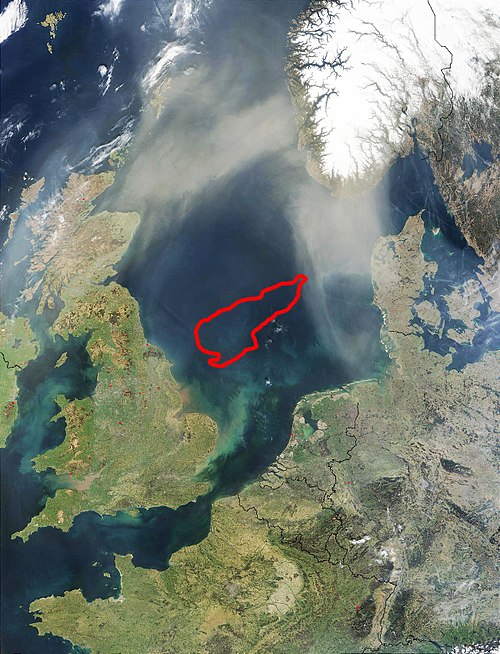
The red line marks Dogger Bank, which is most likely a moraine formed in the Pleistocene

A Woolly mammoth skull discovered by fishermen in the North Sea, at the Celtic and Prehistoric Museum, Ireland