Prime Minister of India
Videos
The prime minister of India is the head of government of the Republic of India. Executive authority is vested in the prime minister and his chosen Council of Ministers, despite the President of India
The official portrait of Shri Narendra Modi, the Prime Minister of the Republic of India


Former Prime Minister Manmohan Singh with the former Prime Minister Atal Bihari Vajpayee in New Delhi on May 24, 2004

Prime minister Narendra Modi addressing the 69th United Nations General Assembly, c. 2014
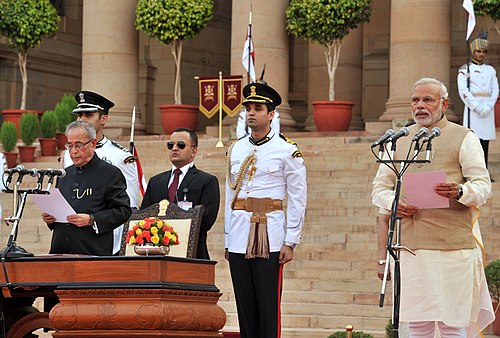
First swearing-in ceremony of Narendra Modi, 2014
Narendra Modi
Videos
Narendra Damodardas Modi is an Indian politician who has served as the prime minister of India since 26 May 2014. Modi was the chief minister of Gujarat from 2001 to 2014 and is the Member of Parliame
Prime Minister of India
…a decade with five unstable governments began. This was followed by the full terms of P. V. Narasimha Rao, Atal Bihari Vajpayee, Manmohan Singh, and Narendra Modi, who is the current prime minister of India, serving since 26 May 2014. He is the first non-Congress leader to become PM after consecutive general…

Modi with Atal Bihari Vajpayee in c. 2001

Modi meeting with then-prime minister of India Manmohan Singh in 2004

The Sardar Sarovar Dam during a 2006 height increase