Prinz Adalbert-class cruiser
Videos
Photos
The Prinz Adalbert class was a group of two armored cruisers built for the German Kaiserliche Marine under the terms of the Second Naval Law. Two ships of the class were built, Prinz Adalbert and Friedrich Carl, between 1900 and 1904. The two ships were heavily based on the previous armored cruiser, Prinz Heinrich, with a series of incremental improvements. Their armor layout was revised slightly to improve internal protection and their main battery consisted of four 21 cm (8.3 in) guns instead of the two 24 cm (9.4 in) carried by Prinz Heinrich. The new ships also received more powerful propulsion systems, making them slightly faster. Prinz Adalbert spent her peacetime career as a gunnery training ship while Friedrich Carl initially served as the flagship of the fleet's reconnaissance forces. By 1909, she had been replaced by more modern cruisers and joined Prinz Adalbert as a training vessel.

SMS Prinz Adalbert

Friedrich Karl leading a line of ships
Imperial German Navy
Videos
Photos
The Imperial German Navy or the Kaiserliche Marine was the navy of the German Empire, which existed between 1871 and 1919. It grew out of the small Prussian Navy, which was mainly for coast defence. Kaiser Wilhelm II greatly expanded the navy. The key leader was Admiral Alfred von Tirpitz, who greatly expanded the size and quality of the navy, while adopting the sea power theories of American strategist Alfred Thayer Mahan. The result was a naval arms race with Britain, as the German navy grew to become one of the greatest maritime forces in the world, second only to the Royal Navy.

Major elements of the High Seas Fleet in the early 1910s

Proclamation of Wilhelm I as Emperor of Germany at Versailles, France in 1871
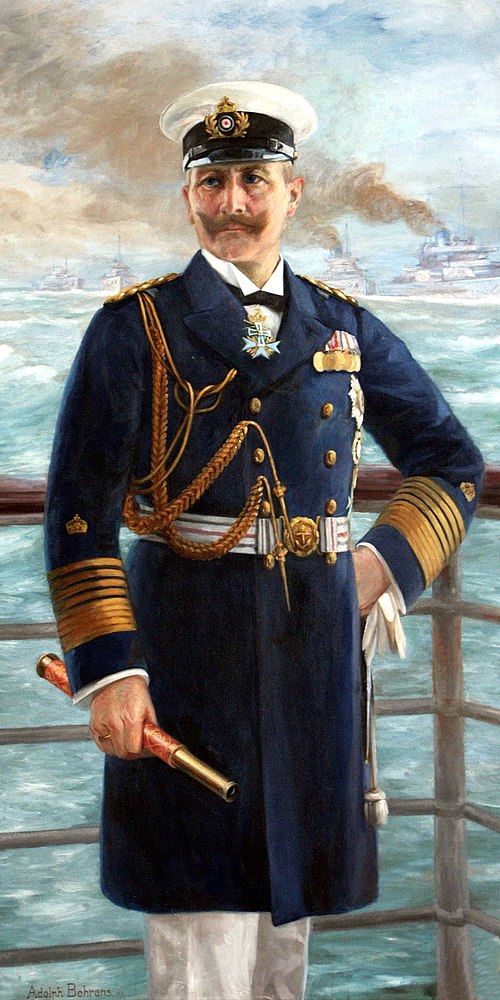
Wilhelm II in German Admiral's uniform in 1913

Alfred von Tirpitz