Proscenium
Videos
A proscenium is the virtual vertical plane of space in a theatre, usually surrounded on the top and sides by a physical proscenium arch and on the bottom by the stage floor itself, which serves as the
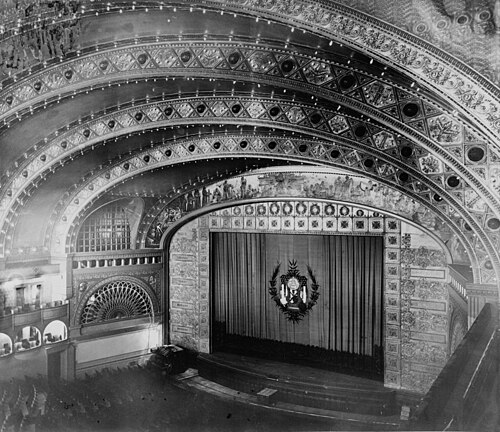
The proscenium arch of the theatre in the Auditorium Building in Chicago. The proscenium arch is the frame decorated with square tiles that forms the vertical rectangle separating the stage (mostly behind the lowered curtain) from the auditorium (the area with seats).

Roman theatre view: 1) Scaenae frons 2) Porticus post scaenam 3) Pulpitum 4) Proscaenium 5) Orchestra 6) Cavea 7) Aditus maximus 8) Vomitorium, Roman theatre of Bosra, Syria

View of the seating area and part of the stage at the Teatro Olimpico (1585) in Vicenza, Italy. No proscenium arch divides the seating area from the "proscenium" (stage), and the space between the two has been made as open as possible, without endangering the structural integrity of the building.

The "proscenium" (stage) at the Teatro Olimpico. The central archway in the scaenae frons (or proscenium) was too small to serve as a proscenium arch in the modern sense, and was in practice always part of the backdrop to the action on-stage.
Fourth wall
Videos
The fourth wall is a common convention in narrative drama in which a metaphorical, invisible, or imaginary wall separates performers from the audience, so that the audience sees through this "wall" in
Proscenium
…which the audience observes from a more or less unified angle the events taking place upon the stage during a theatrical performance. The concept of the fourth wall of the theatre stage space that faces the audience is essentially the same. It can be considered as a social construct which divides the actors and…

In Stanislavski's production of The Cherry Orchard (Moscow Art Theatre, 1904), a three-dimensional box set gives the illusion of a real room. The actors act as if unaware of the audience, separated by an invisible "fourth wall", defined by the proscenium arch.

Typical stage, fourth wall being the house

Josef Forte, as Dr. Alfred Carroll, breaks the fourth wall to warn viewers at the end of Reefer Madness, 1936.