Prussia
Videos
Prussia was a German state centred on the North European Plain. It originated from the 1525 secularization act of the Prussian part of the State of the Teutonic Order. For centuries, the House of Hohe

Situation after the conquest in the late 13th century. Areas in purple under control of the Monastic State of the Teutonic Knights.
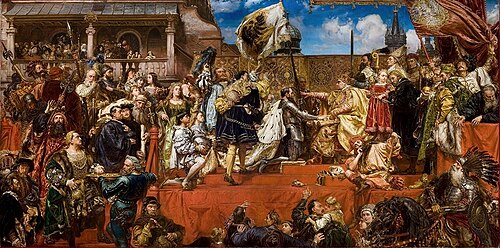
Prussian Homage by Jan Matejko. After admitting the dependence of Prussia to the Polish Crown, Albert of Prussia receives Ducal Prussia as a fief from King Sigismund I the Old of Poland in 1525.

The "Great Elector" and his wife

Frederick I, King in Prussia
German Empire
Videos
The German Empire, also referred to as Imperial Germany or the Second Reich, was the period of the German Reich from the unification of Germany in 1871 until the November Revolution in 1918, when Germ
Prussia
…its capital at Königsberg and then, when it became the Kingdom of Prussia in 1701, Berlin, decisively shaped the history of Germany. Prussia formed the German Empire when it united the German states in 1871. It was de facto dissolved by an emergency decree transferring powers of the Prussian government to German…

Chancellor Otto von Bismarck (pictured in 1873)

Emperor Wilhelm I (pictured c. 1870)

Die Proklamation des Deutschen Kaiserreiches by Anton von Werner (1877), depicting the proclamation of Emperor William I (18 January 1871, Palace of Versailles). From left, on the podium (in black): Crown Prince Frederick (later Frederick III), his father the emperor, and Frederick I of Baden, proposing a toast to the new emperor. At center (in white): Otto von Bismarck, first Chancellor of Germany, Helmuth von Moltke the Elder, Prussian Chief of Staff.

Berlin Palace, the main residence of the House of Hohenzollern