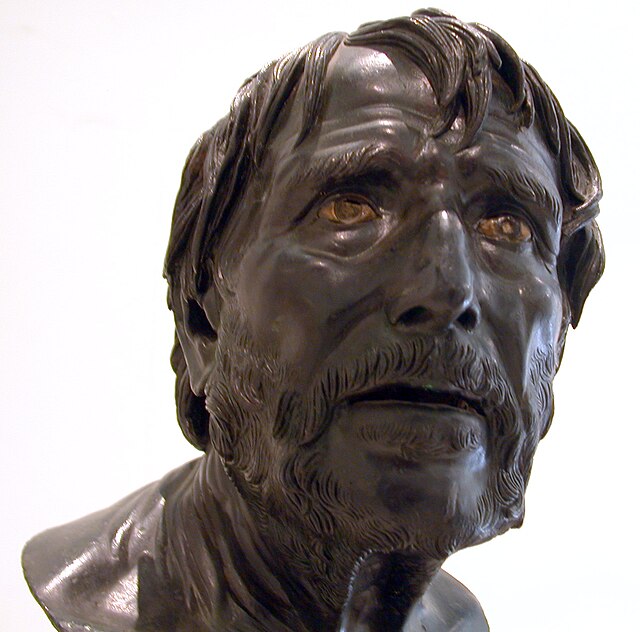
The Pseudo-Seneca is a Roman bronze bust of the late 1st century BC that was discovered in the Villa of the Papyri at Herculaneum in 1754, the finest example of about two dozen examples depicting the same face. It was originally believed to depict Seneca the Younger, the notable Roman philosopher, because its emaciated features were supposed to reflect his Stoic philosophy. However, modern scholars agree it is likely a fictitious portrait, probably intended for either Hesiod or Aristophanes. It is thought that the original example was a lost Greek bronze of c. 200 BC. The bust is conserved in the Museo Archeologico Nazionale, Naples.
Pseudo-Seneca bust recovered from the Villa of the Papyri in Herculaneum MANN 5616
Roman bronze bust, the so-called Pseudo-Seneca, now generally identified as an imaginative portrait of either Hesiod or Aristophanes (Museo Archeologico Nazionale, Naples)
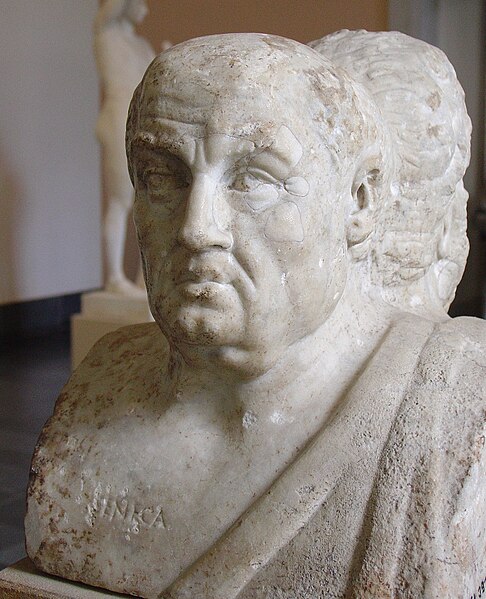
Bust of Seneca, part of the double herm discovered in 1813 (Antikensammlung Berlin)
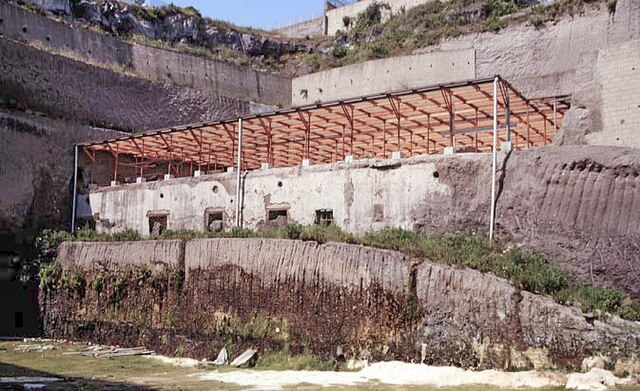
The Villa of the Papyri was an ancient Roman villa in Herculaneum, in what is now Ercolano, southern Italy. It is named after its unique library of papyri scrolls, discovered in 1750. The Villa was considered to be one of the most luxurious houses in all of Herculaneum and in the Roman world. Its luxury is shown by its exquisite architecture and by the large number of outstanding works of art discovered, including frescoes, bronzes and marble sculpture which constitute the largest collection of Greek and Roman sculptures ever discovered in a single context.
Villa of the Papyri
The Villa of the Papyri before the eruption.
A bronze bust of an Egyptian priest, mid 1st century BC, found in the Villa of the Papyri
Barker identified this sculpture as Mercury. It has been referred to as Seated Hermes.