Ptychography
Videos
Ptychography is a computational microscopy technique that reconstructs the complex-valued image of a specimen from a series of coherent diffraction patterns recorded as a localized probe is scanned wi
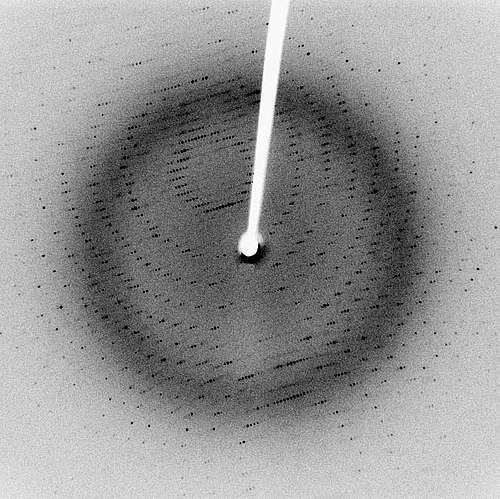
The diffraction pattern of a beam of x-rays passing through a stationary crystal. The dots are areas of constructive interference; the crystal's atomic structure can be worked out from the pattern. In ptychography, a sample (which does not need to be crystalline) is moved sequentially through the beam, creating a range of diffraction patterns.

A visible-light ptychograph of a USAF optical resolution target, made using a pinhole aperture in a piece of cardboard. In the graphs, the hue represents the phase, and the modulus represents the luminance. (a) shows a single image with complex diffraction detail. (b) shows the computer-processed version of (a). (c) shows the result from combined computer-processed diffraction data after the whole sample was scanned.

X-ray ptychography at a small-angle scattering beamline of a synchrotron. This x-ray ptychograph of a zone plate shows the luminosity data in image (a) and the phase data in image (b). Insets I, II and III from (b) are shown in (i), (j) and (k) respectively as processed in 2015; they show a clear improvement in resolution over the algorithms used in 2008 shown in (l), (m) and (n).
Fraunhofer diffraction
Videos
In optics, the Fraunhofer diffraction equation is used to model the diffraction of waves when plane waves are incident on a diffracting object, and the diffraction pattern is viewed at a sufficiently
Diffraction glass with 300 lines per millimeter


Continuous broadside array of point sources of length a

Computer simulation of Fraunhofer diffraction by a rectangular aperture

Computer simulation of the Airy diffraction pattern