Publius Clodius Pulcher
Videos
Publius Clodius Pulcher was a Roman politician and demagogue. A noted opponent of Cicero, he was responsible during his plebeian tribunate in 58 BC for a massive expansion of the Roman grain dole as w

Denarius attributed to, among others, Appius Claudius Pulcher, Clodius' father, minted in 111 or 110 BC. It depicts a helmeted Roma on the obverse with Victory leading a three-horse chariot (triga).

Fictitious portrait of Catiline, the leader of the Catilinarian conspiracy, in the painting Cicero denounces Catiline in the Roman senate by Cesare Maccari (19th century)

Portrait of Cicero from the 1st century AD, currently in the Capitoline Museums. Clodius likely supported Lucius Licinius Murena and Cicero during the crisis.

Statue of Bona Dea, the goddess whose rites in the pontifex maximus' house Clodius infiltrated
Julius Caesar
Videos
Gaius Julius Caesar was a Roman general, statesman, and author who was the dictator of the Roman Republic almost continuously from 49 BC until his assassination in 44 BC. A member of the First Triumvi
The Tusculum portrait, the only extant contemporary sculpture of Caesar


Sulla, depicted on the obverse of a denarius minted by Quintus Pompeius Rufus in 54 BC. Sulla took the city in 82 BC, purged his political enemies, and instituted new constitutional reforms.
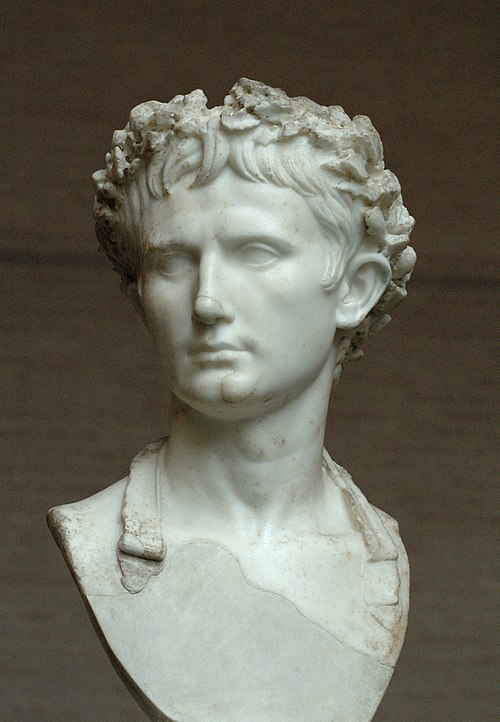
Imperial period bust of Augustus (known as the Augustus Bevilacqua) wearing the civic crown (Latin: corona civica). Caesar won the civic crown for his bravery at the Siege of Mytilene in 81 BC.

Denarius of C. Cossutius Maridianus, 44 BC, with the head of Julius Caesar as pontifex maximus on the obverse. The legend on the reverse mentions the A. A. A. F. F.