Qin (state)
Videos
Qin was an ancient Chinese state during the Zhou dynasty. It is traditionally dated to 897 BC. The state of Qin originated from a reconquest of western lands that had previously been lost to the Xiron
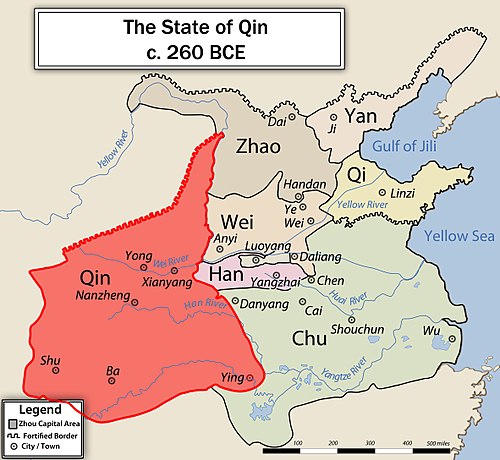
EN QIN260BCE

Bronze mold for minting banliang coins, Warring States period (475–221 BC), State of Qin, from an excavation in Qishan County, Baoji, Shaanxi

Belt plaque in the shape of a standing wolf, characteristic of nomadic artifacts of southern Ningxia and southeastern Gansu, with characteristic surface decorations in the Qin style. 4th century BC.

Bronze door knocker, Xianyang Palace
Warring States period
Videos
The Warring States period in Chinese history comprises the final centuries of the Zhou dynasty, which were characterized by warfare, bureaucratic and military reform, and political consolidation. It f
Qin (state)
…geography and, responding to growing external threats, gradually turned to intervention in the manner of "defensive imperialism". During the early Warring States period, its neighbours in the Central Plains began rapidly developing. The Wei state, formed from the partition of Jin, became the most powerful state on Qin's…

The seven Warring States of Yan, Zhao, Han, Wei, Qi, Chu, Qin c. 260 BC

Leather horse armour from the tomb of Marquis Yi of Zeng c. 433 BC

Warring States bronze warriors.

A carved-jade dragon garment ornament from the Warring States period