Quadrupole ion trap
Videos
In experimental physics, a quadrupole ion trap or paul trap is a type of ion trap that uses dynamic electric fields to trap charged particles. They are also called radio frequency (RF) traps or Paul traps in honor of Wolfgang Paul, who invented the device and shared the Nobel Prize in Physics in 1989 for this work. It is used as a component of a mass spectrometer or a trapped ion quantum computer.

Charged flour grains caught in a quadrupole ion trap

Linear Ion Trap at the University of Calgary

LTQ (Linear trap quadrupole)
Mass spectrometry
Videos
Mass spectrometry (MS) is an analytical technique that is used to measure the mass-to-charge ratio of ions. The results are presented as a mass spectrum, a plot of intensity as a function of the mass-to-charge ratio. Mass spectrometry is used in many different fields and is applied to pure samples as well as complex mixtures.

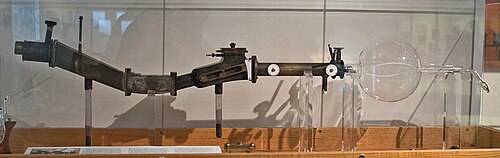
Replica of F.W. Aston's third mass spectrometer

Calutron mass spectrometers were used in the Manhattan Project for uranium enrichment.

Surface ionization source at the Argonne National Laboratory linear accelerator