Quenching (astronomy)
Videos
In astronomy, quenching refers to the shutting-down of star formation within a galaxy. A galaxy where star formation has quenched is known as a quenched or quiescent galaxy. Quenching is an important

NGC 4150, a quiescent elliptical galaxy in the Coma Berenices constellation

The Cosmic Cliffs, an active star-forming region in NGC 3324. Across cosmic time, star formation rates in our modern Universe are actually much lower than previous epochs.

Eridanus II, a dwarf galaxy quenched solely by supernova feedback

The astrophysical jet of M87. Astrophysical jets are a type of active galactic nucleus (AGN) feedback that can heat up previously cold gas and prevent quenching.
Starburst galaxy
Videos
A starburst galaxy is one undergoing an exceptionally high rate of star formation, as compared to the long-term average rate of star formation in the galaxy, or the star formation rate observed in mos
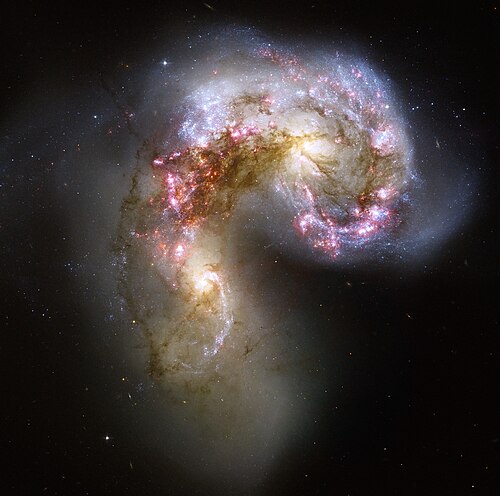
The Antennae Galaxies are an example of a starburst galaxy occurring from the collision of NGC 4038/NGC 4039. Credit: NASA/ESA.

Light and dust in a nearby starburst galaxy known as 2MASS J082354.96+280621.6

Artist's impression of a galaxy undergoing a starburst

SBS 1415+437 is a WR galaxy located about 45 million light-years from Earth.