R136a1
Videos
R136a1 is the most massive and luminous star known, at around 291 solar masses and around 7.2 million times the Sun's luminosity. It is a Wolf–Rayet star at the center of R136, the central concentrati
A near-infrared image of the R136 cluster. R136a1 is at the center with R136a2 close by, R136a3 below right, and R136b to the left. Credit: ESO/VLT


Zooming in from the Tarantula Nebula to the R136 cluster, with R136a1/2/3 visible as the barely resolved knot at bottom right

Sharpest image ever of R136a1, right at the centre of this image, resolving a close companion

Left to right: a red dwarf, the Sun, a B-type main sequence star, and R136a1
Wolf–Rayet star
Videos
Wolf–Rayet stars, often abbreviated as WR stars, are a rare heterogeneous set of stars with unusual spectra showing prominent broad emission lines of ionised helium and highly ionised nitrogen or carb

WR 136, a WN6 star where the atmosphere shed during the red supergiant phase has been shocked by the hot, fast WR winds to form a visible bubble nebula
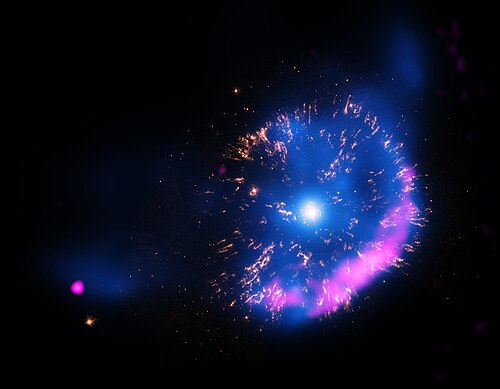
GK Persei (Nova Persei 1901), which showed Wolf–Rayet features in its spectrum

WR 22 in the Carina Nebula

AB7 produces one of the highest excitation nebulae in the Magellanic Clouds.