Racism in Canada
Videos
Photos
Racism in Canada traces both historical and contemporary racist community attitudes, as well as governmental negligence and political non-compliance with United Nations human rights standards and incidents in Canada. Contemporary Canada is the product of indigenous First Nations combined with multiple waves of immigration, predominantly from Europe and in modern times, from Asia.

Ku Klux Klan members, on foot and horseback, by a cross erected in a field near Kingston, Ontario, in 1927

Boarded windows and storefronts on Pender Street in Chinatown after the September 1907 riots

A Royal Canadian Navy officer questions Canadian fishermen of Japanese descent as their boats were confiscated.
Internment of Japanese Canadians
Videos
Photos
From 1942 to 1949, Canada forcibly relocated and incarcerated over 22,000 Japanese Canadians—comprising over 90% of the total Japanese Canadian population—from British Columbia in the name of "national security". The majority were Canadian citizens by birth and were targeted based on their ancestry. This decision followed the events of the Japanese Empire's war in the Pacific against the Western Allies, such as the invasion of Hong Kong, the attack on Pearl Harbor in Hawaii, and the Fall of Singapore which led to the Canadian declaration of war on Japan during World War II. Similar to the actions taken against Japanese Americans in neighbouring United States, this forced relocation subjected many Japanese Canadians to government-enforced curfews and interrogations, job and property losses, and forced repatriation to Japan.

Japanese Canadian evacuation Hastings Park – kindergarten

Lemon Creek Internment camp, June 1944, Slocan Valley, British Columbia (Canada)
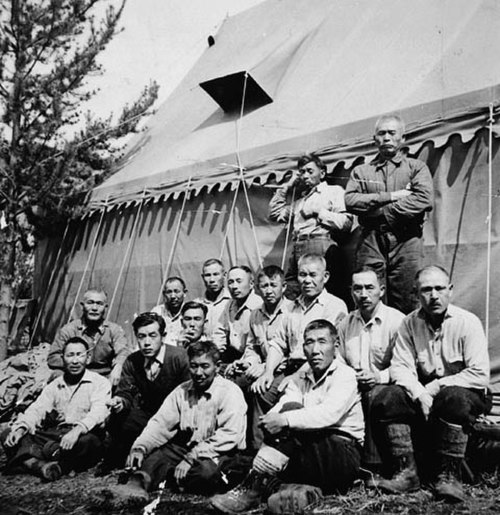
A road crew of interned men building the Yellowhead Highway

The Nikkei Internment Memorial Centre, a National Historic Site of Canada