Raman scattering
Videos
In chemistry and physics, Raman scattering or the Raman effect is the inelastic scattering of photons by matter, meaning that there is both an exchange of energy and a change in the light's direction.
First page of Molecular Diffraction of Light (1922)

C. V. Raman
Videos
Chandrasekhara Venkata Raman was an Indian physicist known for his work in the field of light scattering. Using a spectrograph that he developed, he and his student K. S. Krishnan discovered that when
Raman scattering
…possibilities. More complex techniques involving pulsed lasers, multiple laser beams and so on are known. The Raman effect is named after Indian scientist C. V. Raman, who discovered it in 1928 with assistance from his student K. S. Krishnan. Raman was awarded the 1930 Nobel Prize in Physics for his discovery of Raman…

Raman in 1930

Raman at the 1930 Nobel Prize Award Ceremony with other winners, from left C. V. Raman (physics), Hans Fischer (chemistry), Karl Landsteiner (medicine) and Sinclair Lewis (literature)
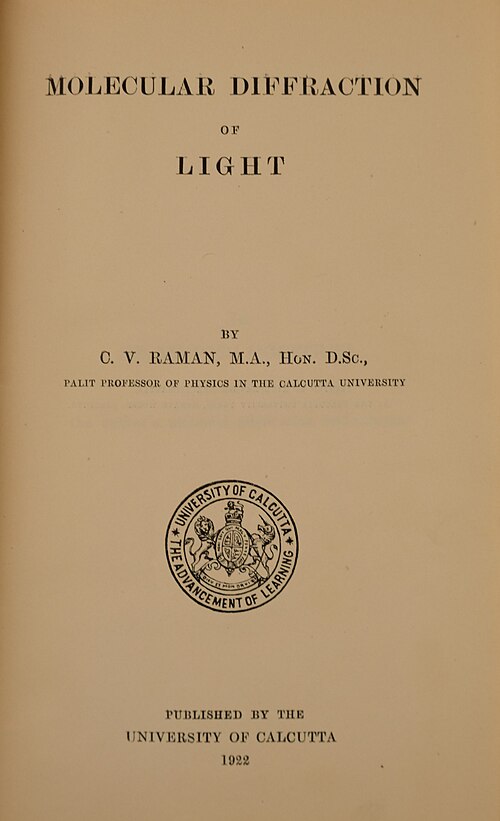
Title page to Raman's Molecular Diffraction of Light (1922)
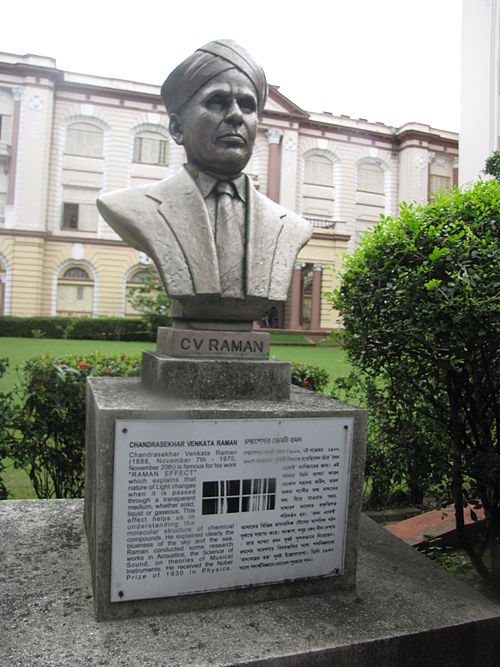
Bust of Chandrasekhara Venkata Raman in the garden of Birla Industrial & Technological Museum