Ramanuja, also known as Ramanujacharya, was an Indian Hindu philosopher, guru and a social reformer. He is noted to be one of the most important exponents of the Sri Vaishnavism tradition within Hinduism. His philosophical foundations for devotionalism were influential to the Bhakti movement.
The figure of Ramanuja in Upadesa Mudra inside the Ranganathaswamy Temple, Srirangam. It is believed to be his preserved mortal remains.
Statue of Equality, Hyderabad
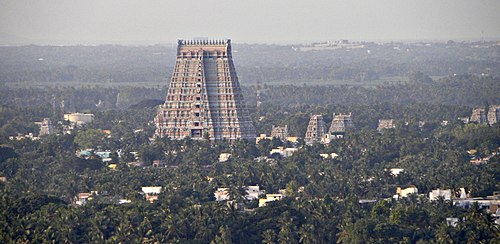
Major Vaishnava temples are associated with the Ramanuja's tradition, such as the above Srirangam Ranganatha temple in Tamil Nadu.
The Bhakti movement was a significant religious movement in medieval Hinduism that sought to bring religious reforms to all strata of society by adopting the method of devotion to achieve salvation. Originating in Tamilakam during 6th century CE, it gained prominence through the poems and teachings of the Vaishnava Alvars and Shaiva Nayanars before spreading northwards. It swept over east and north India from the 15th century onwards, reaching its zenith between the 15th and 17th century CE.
The Vaishnavite Saint Nammalvar. He is one of the most prominent of the 12 Alvars of the Vaishnavism Bhakti movement.
A copper alloy sculpture of a Shiva Bhakti practitioner from Tamil Nadu (11th Century or later).
Nammalvar (c. 798 CE), one of the Tamil Alvars and author of the Tiruvaymoli and the Tiruviruttam
Nayanars gallery at the Thiruthalinathar Shiva temple, Tiruppathur, a Shaiva Siddhanta temple. One important foundation of the Shaiva Siddhantha tradition is the Shaiva bhakti of the Nayanars.