A real-time polymerase chain reaction is a laboratory technique of molecular biology based on the polymerase chain reaction. It monitors the amplification of a targeted DNA molecule during the PCR, no

Real time PCR uses fluorophores in order to detect levels of gene expression.

(1) In intact probes, reporter fluorescence is quenched. (2) Probes and the complementary DNA strand are hybridized and reporter fluorescence is still quenched. (3) During PCR, the probe is degraded by the Taq polymerase and the fluorescent reporter released.

Distinct fusion curves for a number of PCR products (showing distinct colours). Amplification reactions can be seen for a specific product (pink, blue) and others with a negative result (green, orange). The fusion peak indicated with an arrow shows the peak caused by primer dimers, which is different from the expected amplification product.
Intercalation (biochemistry)
Videos
In biochemistry, intercalation is the insertion of molecules between the planar bases of deoxyribonucleic acid. This process is used as a method for analyzing DNA and it is also the basis of certain k
Real-time polymerase chain reaction
…a certain amount of DNA molecules). Two common methods for the detection of PCR products in real-time PCR are (1) non-specific fluorescent dyes that intercalate with any double-stranded DNA and (2) sequence-specific DNA probes consisting of oligonucleotides that are labelled with a fluorescent reporter, which…
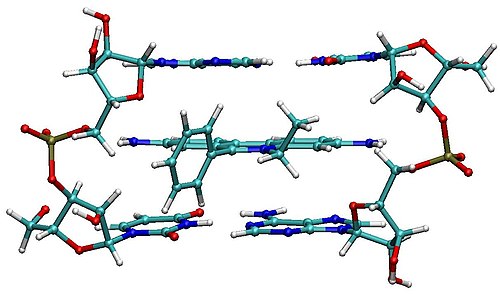
Ethidium intercalated between two adenine-thymine base pairs.