The recent African origin of modern humans or the "Out of Africa" theory holds that present-day humans outside Africa descend mainly from a single expansion of anatomically modern humans from Africa a

Expansion of early modern humans from Africa through the Near East

Layer sequence at Ksar Akil in the Levantine corridor, and discovery of two fossils of Homo sapiens, dated to 40,800 to 39,200 years BP for "Egbert", and 42,400–41,700 BP for "Ethelruda".
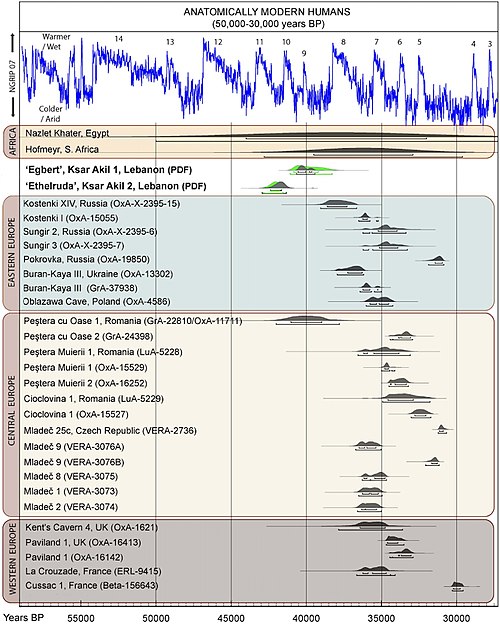
Anatomically Modern Humans known archaeological remains in Europe and Africa, directly dated, calibrated carbon dates as of 2013.

The frontispiece to Huxley's Evidence as to Man's Place in Nature (1863): the image compares the skeleton of a human to other apes.
Neanderthal
Videos
Neanderthals are an extinct group of archaic humans who inhabited Europe and Western and Central Asia during the Middle to Late Pleistocene. Neanderthal extinction occurred roughly 40,000 years ago wi
Recent African origin of modern humans
…early migration of the human species. This expansion follows the earlier expansions of hominins out of Africa, accomplished by Homo erectus and then Homo neanderthalensis. The model proposes a "single origin" of Homo sapiens in the taxonomic sense, precluding parallel evolution in other regions of traits considered…

Neanderthal at AMNH

Skullcap of Neanderthal 1, the type specimen, at the Musée de l'Homme, Paris

The site of Kleine Feldhofer Grotte where Neanderthal 1 was discovered

William K. Gregory's The Family Tree of Man exhibit at the American Museum of Natural History, 1924 1) Notharctus 2) Propliopithecus 3) Dryopithecus 4) Java Man 5) Piltdown Man 6) Heidelberg Man 7) Neanderthal Man 8) Cro-Magnon Man 9) Australian Black-fellow (pejorative term for Aboriginal Australians) 10) Hottentot (pejorative term for the Southern African Khoisan) 11) Chinese 12) American Caucasian