At the beginning of 1914 the British Army had a reported strength of 710,000 men including reserves, of which around 80,000 were professional soldiers ready for war. By the end of the First World War
The image of Lord Kitchener was iconic; seen here on the front page of a magazine as drawn by Alfred Leete (1882–1933)


Women handing out white feathers to men in order to shame them into enlisting during the White Feather Campaign. (Arnold Bennett, 1914)

Recruits at the Whitehall Recruiting Office, London. Britain's declaration of war on Germany on 4 August 1914 was greeted for the most part with popular enthusiasm, and resulted in a rush of men to enlist.

A 1914 recruitment poster by the Parliamentary Recruitment Committee shows a Scottish soldier in Belgium, in response to German chancellor Theobald von Bethmann Hollweg having described the Treaty of London (which protected Belgium's independence and neutrality) as a "scrap of paper" when Germany invaded Belgium in August 1914.
Pals battalion
Videos
The pals battalions of World War I were specially constituted battalions of the British Army comprising men who enlisted together in local recruiting drives, with the promise that they would be able t
Recruitment to the British Army during World War I
…terms of service announced on 6 August 1914].. [will be] promoted forthwith to the rank held on discharge.' One early peculiarity was the formation of 'pals battalions': groups of men from the same factory, football team, bank or similar, joining and fighting together. The idea was first suggested at a public meeting…

"Pals" departing from Preston railway station, August 1914

Inspection of the Liverpool Pals, 1915
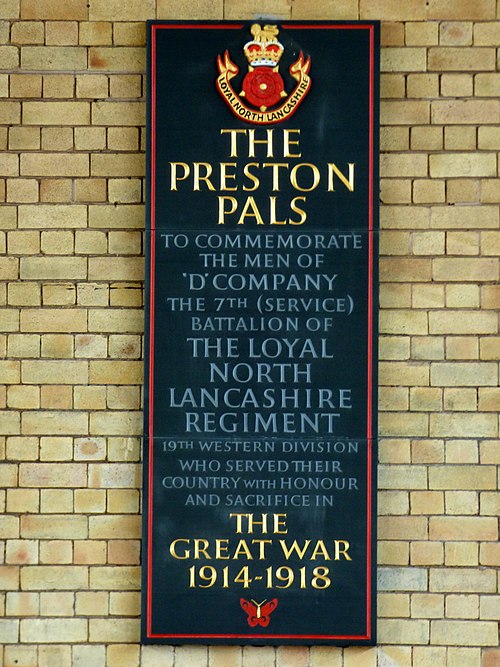
A commemorative plaque for the Preston Pals