Redshift
Videos
In physics, a redshift is an increase in the wavelength, or equivalently, a decrease in the frequency, of electromagnetic radiation. The opposite change, a decrease in wavelength and increase in frequ
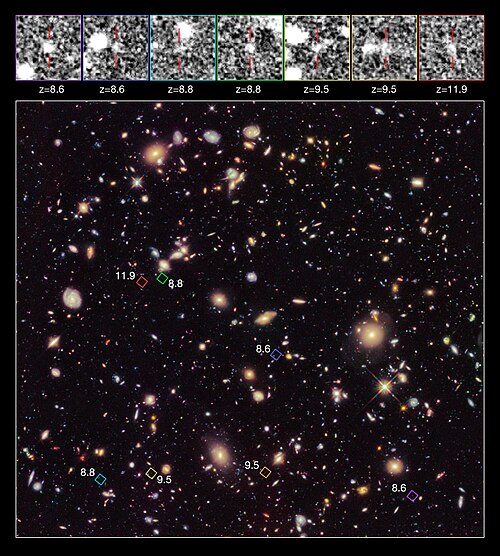
High-redshift galaxy candidates in the Hubble Ultra Deep Field, 2012

Matter waves (protons, electrons, photons, etc.) falling into a gravity well become more energetic and undergo observer-independent blueshifting.
Cosmic microwave background
Videos
The cosmic microwave background, or relic radiation, is microwave radiation that fills all space in the observable universe. With a standard optical telescope, the background space between stars and g
Redshift
…or initially visible light perceived as radio waves. The initial 3000 kelvin (K) radiation from the Big Bang has redshifted far down to become the 3 K cosmic microwave background. Subtler redshifts are seen in the spectroscopic observations of astronomical objects, and are used in terrestrial technologies such as Doppler radar…

The Holmdel Horn Antenna on which Penzias and Wilson discovered the cosmic microwave background.

Comparison of CMB results from COBE, WMAP and Planck (March 21, 2013)

Artist impression of the gravitational lensing effect of massive cosmic structures

Temperature power spectrum and E-mode and B-mode polarization power spectra of the cosmic microwave background