Refractive index
Videos
In optics, the refractive index, often denoted n, is the ratio of the speed of light in vacuum to the speed of light in a given optical medium, n=c/v. The refractive index determines how much the path
Thomas Young coined the term index of refraction in 1807.

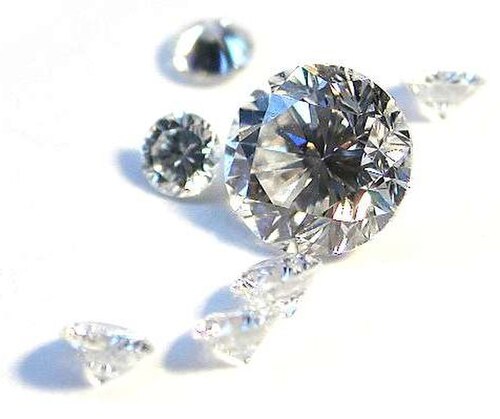
Diamonds have a very high refractive index of 2.417.

A split-ring resonator array arranged to produce a negative index of refraction for microwaves

In optical mineralogy, thin sections are used to study rocks. The method is based on the distinct refractive indices of different minerals.
Moissanite
Videos
Moissanite is naturally occurring silicon carbide and its various crystalline polymorphs. It has the chemical formula SiC and is a rare mineral, discovered by the French chemist Henri Moissan in 1893.
Refractive index
…with aerogel as the clear exception. Aerogel is a very low density solid that can be produced with refractive index in the range from 1.002 to 1.265. Moissanite lies at the other end of the range with a refractive index as high as 2.65. Most plastics have refractive indices in the range from 1.3 to 1.7, but…

A moissanite engagement ring

Moissanite: emerald cut