Reinforced concrete
Videos
Reinforced concrete, also called ferroconcrete or ferro-concrete, is a composite material in which concrete's relatively low tensile strength and ductility are compensated for by the inclusion of rein

A heavy, reinforced concrete column, seen before and after the concrete has been cast in place around its rebar frame
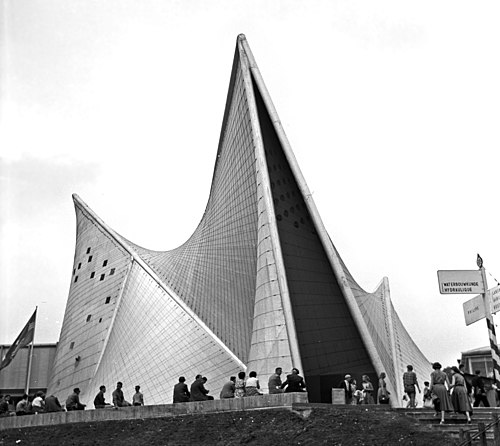
The novel shape of the Philips Pavilion built in Brussels for Expo 58 was achieved using reinforced concrete

François Coignet House at 72 rue Charles-Michels, Saint Denis
![House built by Coignet for his factory workers [fr] at 59-61 rue Charles-Michels, Saint Denis](https://upload.wikimedia.org/wikipedia/commons/thumb/1/18/Maison_de_logement_des_ouvriers_de_l%27usine_Coignet_2020_6.jpg/500px-Maison_de_logement_des_ouvriers_de_l%27usine_Coignet_2020_6.jpg)
House built by Coignet for his factory workers [fr] at 59-61 rue Charles-Michels, Saint Denis
Concrete
Videos
Concrete is a composite material composed of aggregate bound together with a fluid cement that cures to a solid. It is the second-most-used substance, the most widely used building material, and the m
Reinforced concrete
…Reinforced concrete, also called ferroconcrete or ferro-concrete, is a composite material in which concrete's relatively low tensile strength and ductility are compensated for by the inclusion of reinforcement having higher tensile strength or ductility. The…

A single concrete block, as used for construction

Exterior of the Roman Pantheon, finished 128 AD, the largest unreinforced concrete dome in the world.

Interior of the Pantheon dome, seen from beneath. The concrete for the coffered dome was laid on moulds, mounted on temporary scaffolding.

Opus caementicium exposed in a characteristic Roman arch. In contrast to modern concrete structures, the concrete used in Roman buildings was usually covered with brick or stone.