Reionization
Videos
In the fields of Big Bang theory and cosmology, reionization is the process that caused electrically neutral atoms in the primordial universe to reionize after the lapse of the "dark ages". Detecting

Phases of the reionization

Schematic timeline of the universe, depicting reionization's place in cosmic history.

Simulated image of the first stars, 400 million years after the Big Bang.

Astronomers hope to use observations such as this 2018 Hubble Space Telescope image to answer the question of how the Universe was reionised.
Stellar population
Videos
In 1944, Walter Baade categorized groups of stars within the Milky Way into stellar populations. In the abstract of the article by Baade, he recognizes that Jan Oort originally conceived this type of
Reionization
…saying that "only if the ionizing background is dominated by low-luminosity AGNs can the quasar luminosity function provide enough ionizing photons." Population III stars were the earliest stars, which had no elements more massive than hydrogen or helium. During Big Bang nucleosynthesis, the only elements that formed…

Artist's conception of the spiral structure of the Milky Way showing Baade's general population categories. The blue regions in the spiral arms are composed of the younger population I stars, while the yellow stars in the central bulge are the older population II stars. In reality, many population I stars are also found mixed in with the older population II stars.
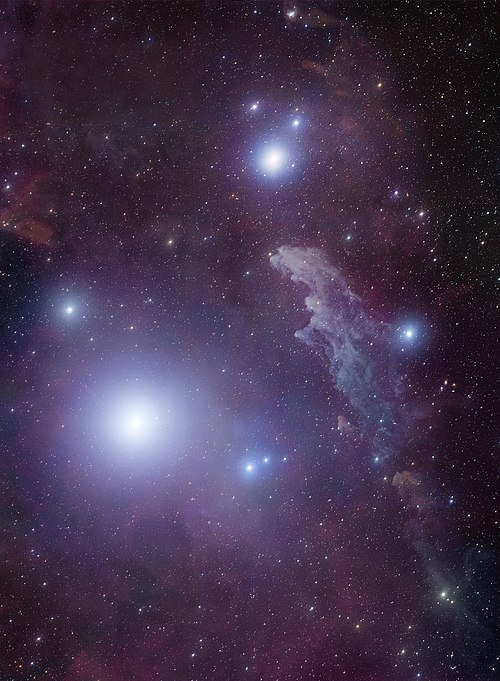
Population I star Rigel with reflection nebula IC 2118

Artist's impression of a field of population III stars 100 million years after the Big Bang.

Possible glow of population III stars imaged by NASA's Spitzer Space Telescope