On 31 December 1952, the Soviet Union returned full control of the Chinese Eastern Railway to the People's Republic of China. The return of the railway marked the first time that the Chinese Eastern R

Franklin Roosevelt, Winston Churchill and Joseph Stalin at Yalta in February 1945. The Yalta Accord decided that the USSR would regain control of the Chinese Eastern Railway and the ports of Dalian and Lüshun.

Harbin railway station while under Soviet management
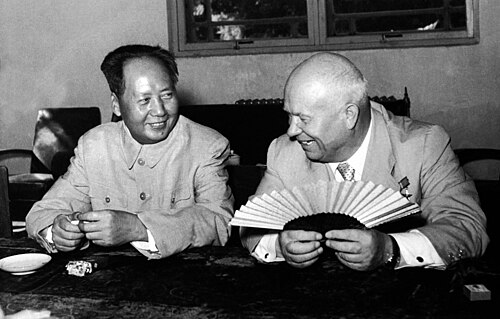
Mao Zedong and Nikita Khrushchev in 1958

Jalainuer Opencast Pit Coal Mine was one of the two coal mines returned to China with the assets of the Chinese Changchun Railway.
Harbin–Manzhouli railway
Videos
Trans-Siberian Railway Harbin–Manzhouli railway, abbreviated as the Binzhou Railway, is a double-track electrified trunk railway in Northeast China between Harbin and Manzhouli on the Russian border,

Sino-Russian border crossing at Manzhouli.

The Binzhou Railway Bridge across the Songhua River in Harbin

Binzhou Railway near Bugt, Hulunbuir, Inner Mongolia.