Revolt of the Comuneros
Videos
The Revolt of the Comuneros was an uprising by citizens of Castile against the rule of Charles I and his administration between 1520 and 1521. At its height, the rebels controlled the heart of Castile

Execution of the Comuneros of Castile, by Antonio Gisbert (1860)

San Pablo Church in Valladolid, seat of a Cortes held in 1518. Protests emerged when the Flemish adviser Jean de Sauvage was named its president, presaging later troubles.

A 1516 portrait of King Charles I of Castile and Aragon, later Holy Roman Emperor Charles V, by Bernard van Orley. Charles would rule one of the largest empires in European history—through his father Philip, Burgundy and the Netherlands; through his mother Joanna, Castile, Aragon, and Naples; and through his grandfather Maximilian and his election in 1519 as Holy Roman Emperor, Germany, Austria, and much of Northern Italy.

Toledo, home of the first Comunidad
Charles V was Holy Roman Emperor and Archduke of Austria from 1519 to 1556, King of Castile and León from 1516 to 1556, King of Sicily and Naples from 1516 to 1554, and also Lord of the Netherlands an
Revolt of the Comuneros
…Comuneros (Spanish: Guerra de las Comunidades de Castilla, "War of the Communities of Castile") was an uprising by citizens of Castile against the rule of Charles I and his administration between 1520 and 1521. At its height, the rebels controlled the heart of Castile, ruling the cities of Valladolid, Tordesillas…
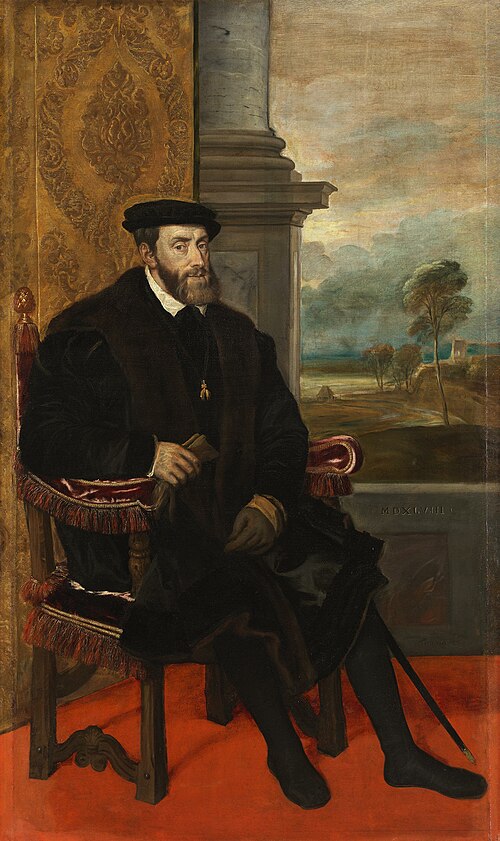
Portrait of Charles V, 1548

The entrance gate to the Prinsenhof, Dutch for "Princes' Court", in Ghent, where Charles V was born.

A painting by Bernhard Strigel representing the extended Habsburg family with a young Charles in the middle

A 1519 portrait of Charles V by Bernard van Orley with the insignia of the Order of the Golden Fleece prominently displayed