Reynolds number
Videos
In fluid dynamics, the Reynolds number is a dimensionless quantity that helps predict fluid flow patterns in different situations by measuring the ratio between inertial and viscous forces. At low Rey
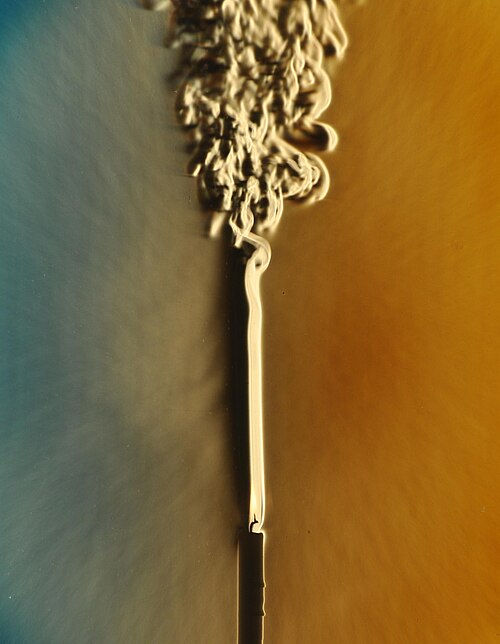
The plume from this candle flame transitions from laminar to turbulent.

George Stokes introduced Reynolds numbers.

The Brezina equation

Universal sedimentation equation — drag coefficient, a function of Reynolds number and shape factor, 2D diagram
Sir George Gabriel Stokes, 1st Baronet, was an Irish mathematician and physicist. Born in County Sligo, Ireland, Stokes spent his entire career at the University of Cambridge, where he served as Lucas
Reynolds number
…such as in local or global air or water movement, and thereby the associated meteorological and climatological effects. The concept was introduced by George Stokes in 1851, but the Reynolds number was named by Arnold Sommerfeld in 1908 after Osborne Reynolds who popularized its use in 1883 (an example of Stigler's…

Fluorspar

Crookes Radiometer

Lord Kelvin