Richard Brandon
Videos
Richard Brandon, also known as Young Gregory, was the common executioner of London from 1639 to 1649, a role which he inherited from his father Gregory Brandon. Brandon is often named as the execution
The title page of The Confession of Richard Brandon, a 1649 pamphlet claiming to contain a confession of Richard Brandon as Charles I's executioner. The posthumous frontispiece shows Richard Brandon after the beheading of Charles I.

William Laud
Videos
William Laud was a bishop in the Church of England. Appointed Archbishop of Canterbury by Charles I in 1633, Laud was a key advocate of Charles I's religious reforms; he was arrested by Parliament in
Richard Brandon
…executions through the English Civil War, including Charles' advisor Thomas Wentworth, 1st Earl of Strafford, on 12 May 1641 and Archbishop of Canterbury William Laud on 10 January 1645. Brandon was the Common Hangman of London in 1649 and he is frequently cited as the executioner of Charles I. The royalist losses…

Portrait by Anthony van Dyck c. 1636

Stained glass windows in the Chapter House of Canterbury Cathedral, depicting Henry IV, Henry VIII, Thomas Cranmer and Archbishop Laud

Altar, c. 1635, the centre of dispute between Puritans and Laudians, possibly consecrated by Laud himself, in St Peter's Collegiate Church in Wolverhampton.
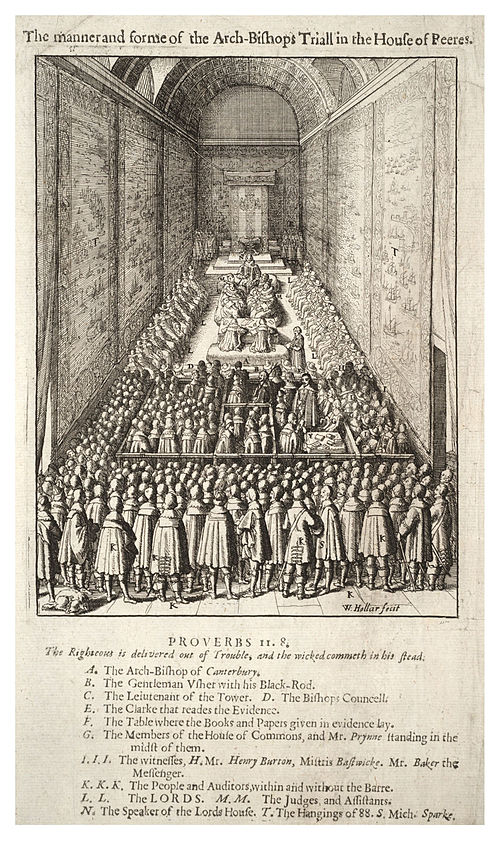
Etching by Wenceslaus Hollar showing Laud being tried for treason in the House of Lords, with several people present labelled