Rigel
Videos
Rigel is a blue supergiant star in the equatorial constellation of Orion. It has the Bayer designation β Orionis, which is Latinized to Beta Orionis and abbreviated Beta Ori or β Ori. Rigel is the bri
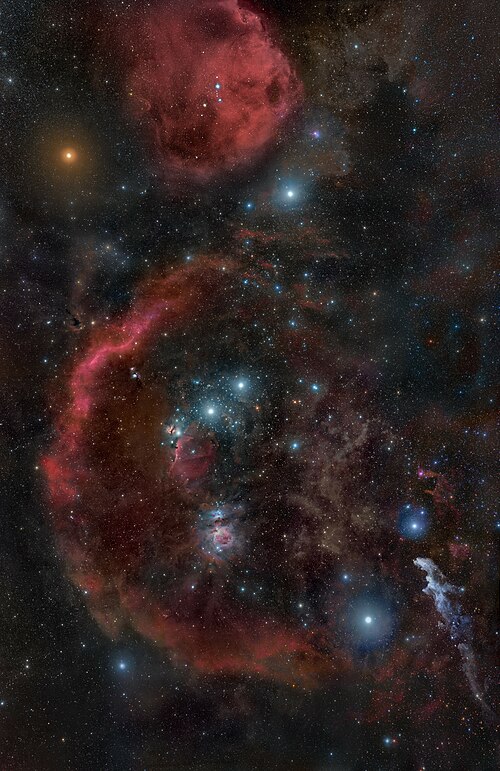
Orion, with Rigel at bottom right, at optical wavelengths plus the Hα (hydrogen-alpha) spectral line to emphasize gas clouds

Rigel A and Rigel B as they appear in a small telescope
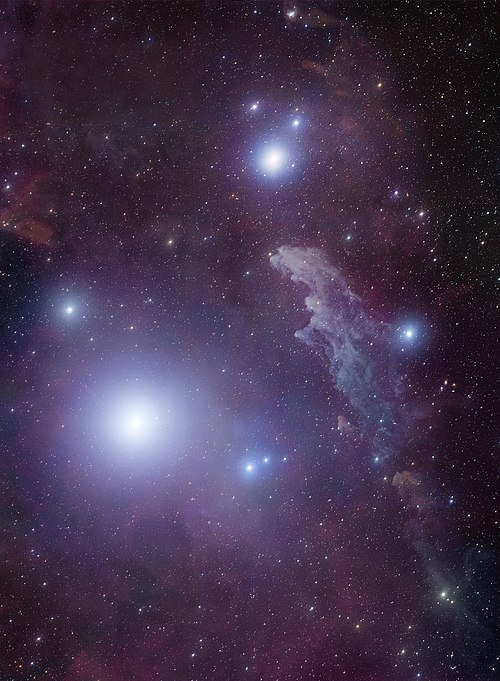
Rigel and reflection nebula IC 2118 in Eridanus. Rigel B is not visible in the glare of the main star.

Orion illustrated in a copy of Abd al-Rahman al-Sufi's Book of Fixed Stars. The foot on the left is annotated rijl al-jauza al-yusra, the Arabic name from which Rigel is derived.
Betelgeuse
Videos
Betelgeuse is a red supergiant star in the equatorial constellation of Orion. It is usually the tenth-brightest star in the night sky and, after Rigel, the second brightest in its constellation. It is
Rigel
…atmosphere. Rigel is generally the seventh-brightest star in the night sky and the brightest star in Orion, though it is occasionally outshone by Betelgeuse, which varies over a larger range. A triple-star system is separated from Rigel by an angle of 9.5 arc seconds. It has an apparent magnitude of 6.7…

1998/9 ultraviolet (UV) Hubble Space Telescope images of Betelgeuse showing asymmetrical pulsations with corresponding spectral line profiles

AAVSO V-band magnitude of Betelgeuse, between September 2016 and August 2023

Comparison of SPHERE images of Betelgeuse taken in January 2019 and December 2019, showing the changes in brightness and shape